
Blog
Types of Vape Juice Explained: A Guide to Different E-Liquids

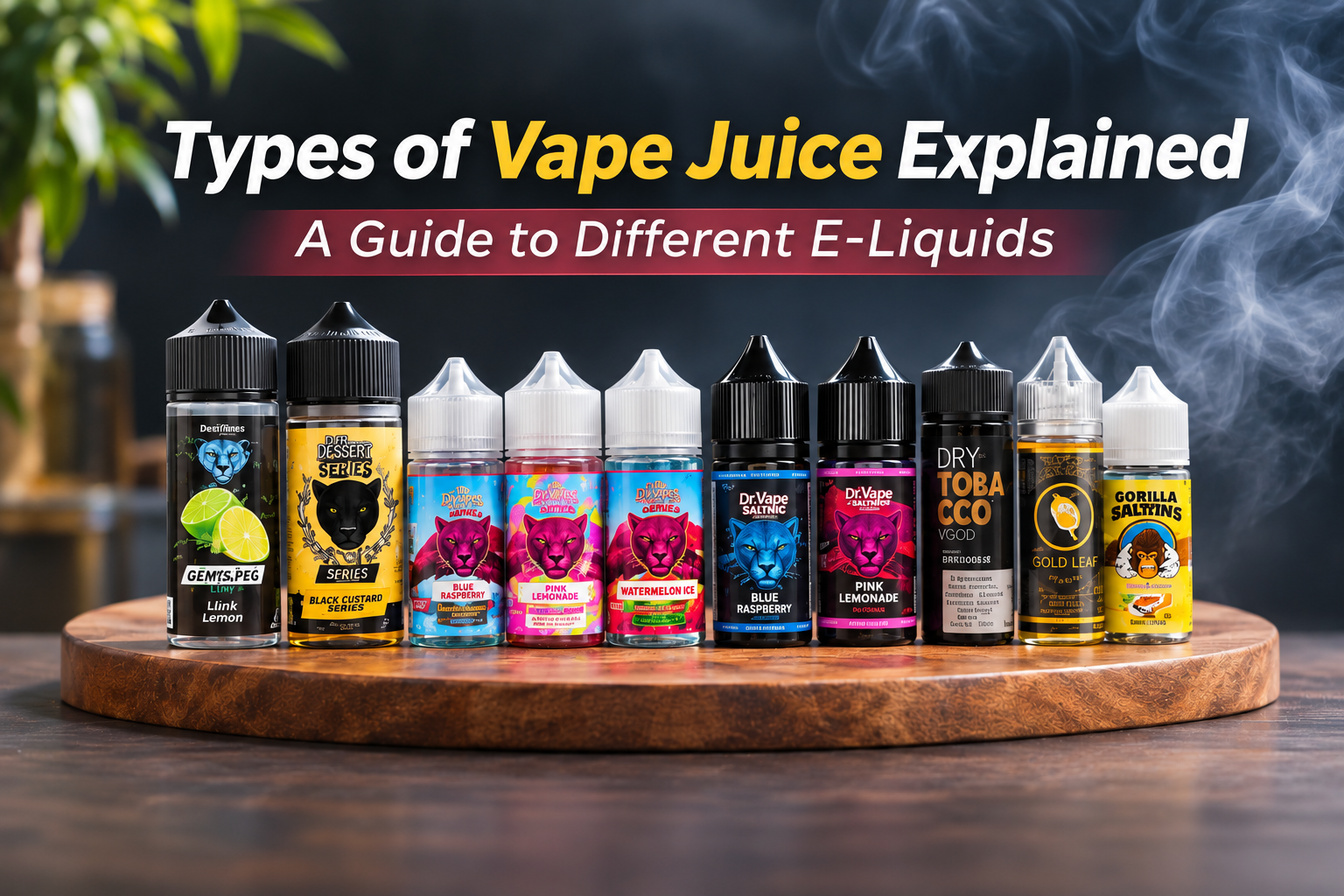
Choosing between different types of vape juice can be confusing because e-liquids are classified in several ways. Some are categorised by nicotine formulation, while others are defined by their VG/PG ratio, flavour profile or packaging format.
The main types of vape juice include freebase nicotine, nicotine salts, nicotine-free e-liquids, high-VG, high-PG and 50/50 formulations. Shortfills and nicotine shots are also common product formats, each with different characteristics and specifications.
For a broader explanation of e-liquid ingredients, composition and health considerations, read our complete guide to what vape juice is.
What Are the Different Types of Vape Juice?
The different types of vape juice are generally classified according to their nicotine formulation, VG/PG ratio and packaging format. Some categories describe the type of nicotine used, while others refer to the liquid’s composition or how it is supplied.
Understanding these distinctions makes it easier to compare e-liquid specifications.
Freebase Nicotine E-Liquid
Freebase nicotine e-liquid contains nicotine in its unprotonated form. It is one of the traditional nicotine formulations used in the e-liquid market.
Freebase e-liquids are available in different nicotine concentrations and VG/PG ratios. Their characteristics depend on the overall formulation and the device for which they are designed.
Key characteristics of freebase nicotine e-liquid:
- Contains nicotine in freebase form.
- Available in different nicotine concentrations.
- Offered in various VG/PG ratios.
- Commonly found in traditional refillable e-liquid ranges.
- Available in a wide variety of flavour profiles.
Freebase nicotine is chemically different from nicotine salts. The two formulations should not be treated as interchangeable.
Nicotine Salt E-Liquid
Nicotine salt e-liquid, commonly called nic salt, contains nicotine combined with an acid to form a nicotine salt. This changes its chemical properties compared with freebase nicotine.
Nicotine salts are commonly available in higher nicotine concentrations than many traditional freebase formulations. They are frequently associated with balanced VG/PG blends and compatible pod systems.
Key characteristics of nicotine salt e-liquid:
- Contains nicotine in salt form.
- Commonly available in higher nicotine concentrations.
- Often formulated with a 50/50 VG/PG ratio.
- Frequently associated with compatible pod devices.
- Available in different flavour categories.
Nicotine salt products are not automatically compatible with every vaping device. Always check the manufacturer’s specifications and applicable nicotine concentration limits.
Nicotine-Free E-Liquid
Nicotine-free e-liquid is formulated without added nicotine. It generally contains a combination of VG, PG and flavouring ingredients, although the exact formulation varies between manufacturers.
These products are often labelled as 0mg or zero-nicotine e-liquids.
Key characteristics of nicotine-free e-liquid:
- Contains no added nicotine.
- Available in different VG/PG ratios.
- Offered in various flavour profiles.
- Compatibility is determined by the formulation and the device’s specifications.
However, nicotine-free does not mean risk-free. The aerosol produced by vaping may still expose users to substances that can affect health.
High VG E-Liquid
High-VG e-liquid contains a greater proportion of Vegetable Glycerin than Propylene Glycol. VG is naturally thicker than PG and contributes to aerosol production.
These formulations are commonly associated with compatible sub-ohm tanks and devices designed to handle thicker liquids.
Key characteristics of high-VG e-liquid:
- Contains a higher proportion of Vegetable Glycerin.
- Has a thicker liquid consistency.
- Generally produces more visible aerosol than high-PG formulations under comparable conditions.
- Often available in different nicotine formulations.
- Requires compatible equipment.
High-VG e-liquid is not suitable for every vaping device. Its thicker consistency may cause feeding or wicking problems in devices designed for thinner liquids.
High PG E-Liquid
High-PG e-liquid contains a greater proportion of Propylene Glycol than Vegetable Glycerin. PG is thinner than VG and is commonly used to carry flavour ingredients.
These formulations have a thinner consistency and are generally associated with a more pronounced throat sensation, although nicotine concentration and device settings also influence the experience.
Key characteristics of high-PG e-liquid:
- Contains a higher proportion of Propylene Glycol.
- Has a thinner liquid consistency.
- Helps carry flavour.
- Generally produces less visible aerosol than high-VG formulations under comparable conditions.
- Commonly found in compatible lower-powered devices.
As with high-VG formulations, device compatibility should always be checked before use.
50/50 E-Liquid
50/50 e-liquid contains equal proportions of Vegetable Glycerin and Propylene Glycol. This formulation is commonly used throughout the e-liquid industry.
This balanced composition combines the characteristics of both base ingredients, creating a middle-ground formulation in terms of viscosity and aerosol production.
Key characteristics of 50/50 e-liquid:
- Contains 50% VG and 50% PG.
- Has a balanced liquid consistency.
- Available in freebase, nicotine salt and nicotine-free formulations.
- Commonly associated with compatible refillable pod systems.
- Available in a wide range of flavours.
A 50/50 ratio describes the base-liquid composition, not the nicotine strength. An e-liquid with this ratio can contain different nicotine concentrations or no nicotine at all.
Shortfill E-Liquid
Shortfill e-liquid refers to a bottle format in which the liquid does not fill the entire container. The remaining space is traditionally intended to accommodate additional compatible liquid, such as a nicotine shot, where permitted.
Shortfills are commonly associated with larger-volume e-liquid products and are often available in high-VG formulations.
Key characteristics of shortfill e-liquid:
- Supplied in a partially filled bottle.
- Commonly available in nicotine-free formulations.
- Often associated with high-VG blends.
- Traditionally designed for use with compatible nicotine shots.
- Available in different flavour profiles.
Shortfill describes a packaging format rather than a separate nicotine type or VG/PG ratio.
Product formats and permitted bottle capacities vary between markets. UAE requirements should always be checked before assuming that an internationally available shortfill product complies with local standards.
Nicotine Shots
Nicotine shots, also known as nic shots, are concentrated nicotine-containing liquids designed to be added to compatible nicotine-free e-liquid products where permitted.
They are traditionally associated with shortfill formats. Their nicotine concentration, VG/PG ratio and intended compatibility vary by manufacturer.
Key characteristics of nicotine shots:
- Contain a specified nicotine concentration.
- Available in different VG/PG formulations.
- Designed for compatible e-liquid formats.
- Subject to applicable product and packaging requirements.
Nicotine shots are not a separate flavour category. They are additional nicotine-containing products used with compatible e-liquid formats.
Nicotine is addictive, and products must be handled and stored according to their instructions and applicable safety requirements.
Understanding Different Vape Juice Formulations
Vape juice formulations differ according to their ingredients, nicotine type, nicotine concentration and VG/PG proportions. These elements work together to determine the physical properties and intended device compatibility of an e-liquid.
There are three important formulation elements to understand.
Nicotine Formulation
E-liquids may contain freebase nicotine, nicotine salts or no added nicotine.
Freebase nicotine and nicotine salts have different chemical structures. The nicotine concentration indicates how much nicotine is present in each millilitre of liquid.
VG/PG Composition
VG and PG form the base of most conventional e-liquids.
A higher VG proportion generally creates a thicker liquid, while a higher PG proportion produces a thinner formulation. The ratio also influences the liquid’s overall characteristics.
Flavour Formulation
Manufacturers use different flavour ingredients and combinations to create fruit, menthol, dessert, beverage and other flavour profiles.
The exact ingredients and their suitability must meet applicable product standards.
Can Different Vape Juice Types Overlap?
Yes. Different vape juice categories are not always mutually exclusive because they describe different aspects of the same product.
For example:
- A freebase nicotine e-liquid can have a 50/50 VG/PG ratio.
- A nicotine salt e-liquid can also have a 50/50 formulation.
- A nicotine-free e-liquid can be high VG.
- A shortfill can contain a high-VG, nicotine-free formulation.
This distinction is important when comparing products. Nicotine type, VG/PG ratio and bottle format describe separate characteristics of an e-liquid.
Vape Juice Types Comparison Table
The following table summarises the main types of vape juice, their defining characteristics and common formulations.
| Vape Juice Type | Main Characteristic | Common Formulation |
| Freebase nicotine | Traditional freebase nicotine | Various VG/PG ratios |
| Nicotine salts | Nicotine salt formulation | Commonly 50/50 |
| Nicotine-free | No added nicotine | Various VG/PG ratios |
| High VG | Higher VG proportion | Often 70/30 or higher VG |
| High PG | Higher PG proportion | PG-dominant blends |
| 50/50 | Equal VG and PG | 50% VG / 50% PG |
| Shortfill | Partially filled bottle format | Often high VG |
| Nicotine shots | Separate nicotine-containing liquid | Various VG/PG ratios |
Note: These categories can overlap. For example, an e-liquid can be both nicotine-free and high VG. The table describes the main characteristic of each category rather than suggesting that every product belongs to only one group.
Different E-Liquid Flavour Categories
E-liquid flavours are available in a wide range of profiles, from individual fruit notes to more complex combinations. Manufacturers commonly organise them into flavour categories to make product ranges easier to understand.
Here are some of the common flavour categories found across the e-liquid market.
Fruit Flavours
Fruit-flavoured e-liquids feature flavour profiles inspired by individual fruits or combinations of several fruit varieties.
Common examples include:
- Strawberry
- Watermelon
- Mango
- Blueberry
- Raspberry
- Apple
- Mixed berries
- Tropical fruit
Some formulations focus on a single fruit, while others combine different sweet, sharp and tropical notes.
Menthol and Mint Flavours
Menthol and mint e-liquids feature cooling or mint-inspired flavour profiles.
Common examples include:
- Menthol
- Spearmint
- Peppermint
- Mint
- Ice-inspired flavour combinations
These flavours may also be combined with fruit profiles to create mixed flavour formulations.
Dessert and Sweet Flavours
Dessert-inspired e-liquids take their flavour profiles from familiar sweet foods and confectionery.
Common examples include:
- Vanilla
- Custard
- Caramel
- Chocolate
- Doughnut
- Cake
- Biscuit
These formulations often combine several flavour notes to create more complex profiles.
Beverage-Inspired Flavours
Beverage-inspired e-liquids are formulated around flavour profiles associated with popular drinks.
Examples include:
- Cola
- Lemonade
- Iced coffee
- Fruit drinks
- Energy-drink-inspired flavours
Some products combine beverage profiles with fruit or cooling notes.
Tobacco-Inspired Flavours
Tobacco-inspired e-liquids are formulated to reproduce flavour notes associated with tobacco.
Depending on the manufacturer, these may include:
- Classic tobacco-inspired profiles.
- Rich tobacco notes.
- Tobacco and vanilla combinations.
- Tobacco and caramel combinations.
The actual flavour profile varies between brands and formulations.
Flavour descriptions refer to the intended taste profile, not the product’s safety. E-liquid ingredients and flavour additives must comply with applicable regulations.
Understanding VG/PG Ratios
VG/PG ratio refers to the proportion of Vegetable Glycerin (VG) and Propylene Glycol (PG) in an e-liquid’s base composition. It is usually expressed as two numbers, such as 50/50, 70/30 or 80/20, with the first number representing VG and the second representing PG.
VG is thicker than PG and contributes to aerosol production, while PG has a thinner consistency and helps carry flavour ingredients. The proportion of these ingredients influences the overall characteristics and viscosity of an e-liquid.
Common VG/PG Ratios Explained
| VG/PG Ratio | Composition | General Characteristics |
| 50/50 | Equal VG and PG | Balanced composition |
| 60/40 | Higher VG | Moderately thicker formulation |
| 70/30 | High VG | Thicker formulation |
| 80/20 | Very high VG | Particularly thick formulation |
| 30/70 | High PG | Thinner formulation |
How Does VG/PG Ratio Affect E-Liquid Compatibility?
Different e-liquid formulations have different viscosities, and device specifications may vary accordingly. Some devices are designed for particular liquid compositions, so compatibility should always be checked against the manufacturer’s instructions.
For a more detailed explanation of VG and PG properties, composition and differences, read our guide to PG vs VG in E-Liquid.
Freebase vs Nicotine Salts: Key Differences
Freebase nicotine and nicotine salts are two different nicotine formulations used in e-liquids. Both contain nicotine, but they differ in their chemical form and are commonly associated with different product formulations.
Freebase Nicotine vs Nicotine Salts Comparison
| Comparison Factor | Freebase Nicotine | Nicotine Salts |
| Nicotine form | Unprotonated nicotine | Nicotine combined with an acid |
| Chemical formulation | Freebase form | Protonated nicotine salt |
| Common concentrations | Varies by product | Often available in higher concentrations |
| Common VG/PG ratio | Various ratios | Often 50/50 |
| Device association | Various compatible refillable devices | Compatible pod systems |
The actual nicotine concentration and VG/PG composition vary between products. Neither formulation should be assumed to be compatible with every vaping device.
Both formulations contain nicotine, an addictive substance. Their product specifications and applicable local concentration limits should always be considered.
For a detailed explanation of their chemical differences, ingredients and other relevant facts, read our guide to Freebase vs Salt Nic.
UAE E-Liquid Regulatory Requirements
Under UAE.S 5030:2018, the maximum permitted nicotine concentration in e-liquid is stated as 20mg/ml.
The standard also specifies capacity requirements for electronic nicotine products, including:
- Maximum e-liquid tank capacity: 10ml.
- Maximum e-liquid refill package capacity: 50ml.
These requirements should be checked against the latest applicable UAE regulatory documentation before publication. Product packaging and specifications must comply with the relevant local requirements.
Frequently Asked Questions
- What are the main types of vape juice?
The main types include freebase nicotine, nicotine salts, nicotine-free, high-VG, high-PG and 50/50 e-liquids. Shortfills and nicotine shots are also common product formats.
- What is the difference between freebase nicotine and nicotine salts?
Freebase nicotine is in its unprotonated form, while nicotine salts are formed by combining nicotine with an acid. They differ in chemical formulation and commonly available concentrations.
- What does 50/50 mean in vape juice?
A 50/50 e-liquid contains equal proportions of Vegetable Glycerin (VG) and Propylene Glycol (PG).
- What is the difference between high-VG and high-PG e-liquid?
High-VG e-liquid contains more Vegetable Glycerin, making it thicker, while high-PG e-liquid contains more Propylene Glycol, resulting in a thinner consistency.
- What is a shortfill e-liquid?
A shortfill is an e-liquid supplied in a partially filled bottle, traditionally leaving space for additional compatible liquid where permitted.
- What are nicotine shots used for?
Nicotine shots are concentrated nicotine-containing liquids designed to be added to compatible nicotine-free e-liquid formats where permitted.
- Does nicotine-free vape juice contain nicotine?
Nicotine-free e-liquid is formulated without added nicotine and is generally labelled 0mg. However, it is not necessarily risk-free.
- Which VG/PG ratio is thicker?
Higher-VG ratios are thicker. For example, an 80/20 VG/PG formulation is generally thicker than a 50/50 blend.
- What is the maximum nicotine strength allowed in UAE e-liquid?
Under UAE.S 5030:2018, the maximum permitted nicotine concentration in e-liquid is 20mg/ml.
- Are all types of vape juice compatible with every device?
No. Compatibility depends on the e-liquid formulation and the device manufacturer’s specifications.
Conclusion
Conclusion
Understanding the different types of vape juice involves recognising three main distinctions: nicotine formulation, VG/PG composition and product format. Each category describes a different characteristic of an e-liquid, and several categories can overlap within the same product.
Freebase nicotine, nicotine salts and nicotine-free formulations describe nicotine content and formulation. High-VG, high-PG and 50/50 describe the proportions of Vegetable Glycerin and Propylene Glycol, while shortfills and nicotine shots refer to different product formats. Flavour categories provide another way to classify e-liquids according to their intended flavour profiles.
Understanding these distinctions makes it easier to interpret e-liquid specifications and identify the differences between product categories. For further information, explore our related guides to what vape juice is, PG vs VG in e-liquid and freebase vs nicotine salts.