
Blog
What Is Vape Juice? A Complete Guide to E-Liquid in the UAE

Key takeaways
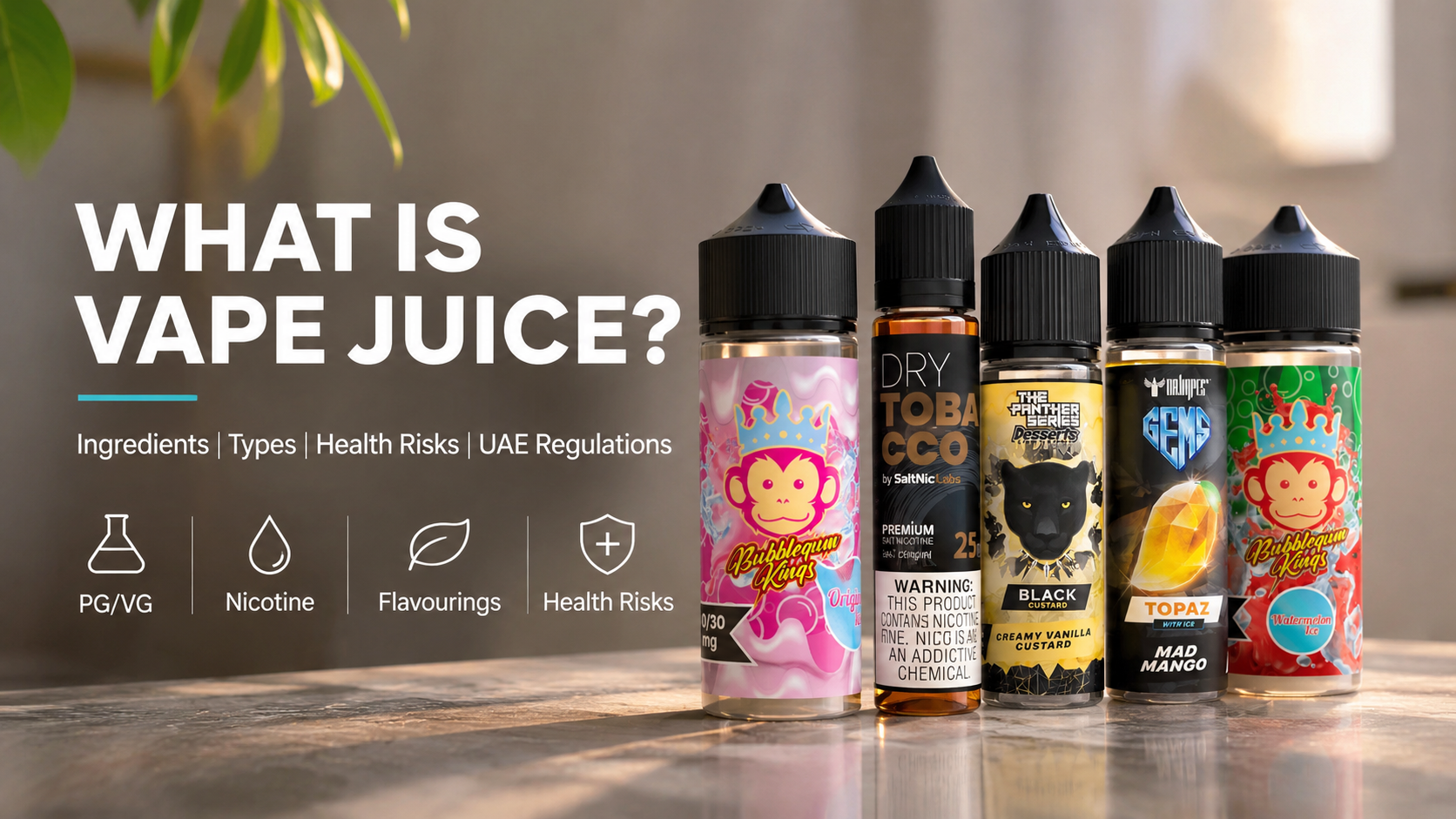
Vape juice, commonly referred to as e-liquid, is the specially formulated liquid used in vaping devices. It generally contains propylene glycol (PG), vegetable glycerin (VG), flavouring ingredients and, in some formulations, nicotine. When heated by an electronic device, the liquid produces an aerosol that users inhale.
Here are the key things to understand about e-liquid:
- Ingredients: Most formulations contain PG, VG, flavouring substances and sometimes nicotine.
- Nicotine: E-liquids are available in different nicotine formulations and concentrations, including nicotine-free products.
- Types: Common classifications include freebase nicotine, nicotine salts, different PG/VG compositions and prefilled or refillable formats.
- Expiration: E-liquid can deteriorate over time, particularly when exposed to heat, light and air.
- Health risks: Nicotine is addictive, and vaping aerosol can contain potentially harmful substances. Nicotine-free does not mean risk-free.
Understanding these details helps readers distinguish between e-liquid terminology, product composition, potential health risks and the regulatory requirements applicable in the UAE.
If you have ever wondered what the liquid inside a vaping device contains, you may have questions about its ingredients, nicotine content and potential health effects.
This liquid is often referred to as vape juice or e-liquid. It typically contains propylene glycol (PG), vegetable glycerin (VG), flavouring substances and, in some formulations, nicotine. When heated by a vaping device, it produces an aerosol that users inhale.
Understanding these ingredients is important because the composition of e-liquid and the substances produced during heating can affect potential health risks.
In this guide, you will learn what vape juice is, how it works, its main ingredients, different types, nicotine strength, expiration and storage considerations. We also explain the UAE’s regulatory requirements and important health information from recognised public health authorities.
What Is Vape Juice?
Vape juice, also known as e-liquid or electronic cigarette liquid, is a liquid formulation designed for use in electronic vaping devices. It may contain nicotine, flavouring substances, solvents and other permitted ingredients.
Unlike traditional tobacco products, e-liquid does not generally contain tobacco leaves. Instead, it consists of a mixture of liquid ingredients that an electronic device heats to produce an inhalable aerosol.
The term vape juice is commonly used in everyday conversations, while e-liquid is more frequently used in technical descriptions, product documentation and regulatory standards.
According to Section 3.7 of UAE.S 5030:2018, electronic liquid refers to a liquid formulation or gel used in electronic vape products or replaceable cartridges. It may contain nicotine, additives, distilled water, solvents, vegetable glycerin and propylene glycol.
Is Vape Juice the Same as E-Liquid?
Yes. Vape juice and e-liquid generally refer to the same product.
The difference is mainly terminology rather than composition. Both describe the liquid used in electronic vaping devices, whether it contains nicotine or is formulated without it.
Other commonly used terms include:
- E-juice: An informal alternative name for electronic liquid.
- Vape liquid: Another common name for e-liquid.
- Electronic cigarette liquid: A more formal description used in technical and regulatory contexts.
Although these terms are often interchangeable, the ingredients and nicotine concentration can differ significantly between formulations.
How Does Vape Juice Work in a Vape Device?
Vape juice works through an electronic heating process that transforms the liquid into an aerosol. A vaping device uses electrical energy to heat a coil, which transfers heat to the e-liquid absorbed by a wick or held within a heating chamber.
A typical electronic vaping device contains several components:
- Battery: Supplies electrical power to the device.
- Heating element: Generates heat using electrical energy.
- Wick or liquid delivery system: Brings e-liquid into contact with the heating element.
- Tank or cartridge: Holds the liquid.
- Mouthpiece: Provides the outlet through which the aerosol is inhaled.
What Happens When E-Liquid Is Heated?
The process involves several stages:
Stage 1: Liquid storage
The e-liquid remains inside a tank, cartridge or integrated liquid reservoir.
Stage 2: Heating
Once the device is switched on, the battery delivers power to the heating element, allowing it to generate heat.
Stage 3: Aerosol formation
The heating element warms the liquid, producing an aerosol containing suspended particles and various chemical substances.
Stage 4: Inhalation
The aerosol travels through the device’s airflow system and exits through the mouthpiece.
It is important to understand that this process does not simply produce harmless water vapour. The resulting aerosol can contain nicotine, fine particles, flavouring chemicals, volatile organic compounds and metals.
The chemical composition depends on the liquid formulation, device characteristics and heating conditions.
Heating conditions can also affect aerosol formation and the breakdown of certain ingredients. Understanding the causes of a burnt vape taste requires considering factors such as heating-element temperature, liquid delivery and device operation.
What Is Vape Juice Made Of?
Vape juice is generally made from a combination of solvents, flavouring substances and, in some formulations, nicotine. The exact ingredients and their concentrations vary between products.
The main components commonly discussed in e-liquid formulations include propylene glycol, vegetable glycerin, nicotine and flavouring ingredients.
Propylene Glycol (PG) vs. Vegetable Glycerin (VG)
Propylene glycol and vegetable glycerin are two common base ingredients in e-liquid formulations. They function as solvents or carrier liquids that help form the liquid mixture.
Although both ingredients are used in different consumer products, their presence in an e-liquid does not establish that inhaling their heated emissions is safe.
What Is Propylene Glycol (PG)?
Propylene glycol (PG) is a colourless, odourless liquid used as a solvent and carrier in various industries, including food, pharmaceutical and cosmetic manufacturing.
In e-liquid, PG helps dissolve and distribute flavouring ingredients. It also has a relatively thin consistency compared with vegetable glycerin.
Important characteristics of PG include:
- Relatively low viscosity.
- Ability to dissolve many flavouring substances.
- Use as a carrier solvent.
- Presence in various consumer and industrial applications.
What Is Vegetable Glycerin (VG)?
Vegetable glycerin (VG), also called glycerol, is a colourless, odourless and relatively thick liquid. It is commonly derived from vegetable-based oils and is used in food, pharmaceutical and personal care products.
In e-liquid formulations, VG functions as a base liquid and contributes to the physical characteristics of the resulting aerosol.
Its main characteristics include:
- Higher viscosity than PG.
- A naturally sweet taste.
- Use as a solvent and humectant.
- Different physical properties from PG.
PG vs. VG: What Is the Difference?
The primary difference between PG and VG is their chemical structure and physical properties. PG has a relatively thin consistency and acts as a solvent and carrier, while VG is thicker and functions as a solvent and humectant. These differences help explain how the two ingredients behave in e-liquid formulations.
| Feature | Propylene Glycol (PG) | Vegetable Glycerin (VG) |
| Full name | Propylene glycol | Vegetable glycerin |
| Appearance | Clear liquid | Clear liquid |
| Viscosity | Relatively thin | Relatively thick |
| Taste | Nearly neutral | Naturally slightly sweet |
| Main function | Solvent and carrier | Solvent and humectant |
| Common applications | Food, pharmaceutical and cosmetic products | Food, pharmaceutical and cosmetic products |
Both ingredients have applications beyond e-liquids. However, safety information about ingestion or topical exposure should not be confused with evidence about inhalation after heating.
Nicotine in Vape Juice
Nicotine is an addictive chemical compound naturally found in tobacco plants. It is included in some e-liquid formulations, while others are manufactured without it.
When an electronic cigarette heats nicotine-containing liquid, the resulting aerosol can deliver nicotine to the respiratory system.
Nicotine concentration is therefore an important characteristic of e-liquid composition.
Some formulations contain nicotine in its freebase form, while others use nicotine salts. These are different chemical formulations that are commonly discussed in the vaping industry.
Nicotine exposure can affect the cardiovascular and nervous systems. It is highly addictive and presents particular risks to adolescents, young adults and pregnant women.
Under Section 4.2.4 of UAE.S 5030:2018, nicotine concentration in electronic liquid must not exceed 20 mg/ml.
Flavourings and Other Ingredients in E-Liquid
Flavouring substances are ingredients used to give e-liquid its particular smell or taste. They may consist of individual flavouring chemicals or combinations of different substances.
Other ingredients may include:
- Distilled water.
- Additional solvents permitted under applicable standards.
- Glycerol.
- Propylene glycol.
- Approved flavouring additives.
However, a substance being permitted for food use does not automatically establish that it is safe to inhale after heating.
Some flavouring chemicals can produce potentially harmful substances under heating conditions. The health effects depend on the chemical composition, concentration and exposure conditions.
The UAE technical standard also identifies several prohibited substances and additives for electronic nicotine products, including certain carbonyl compounds, respiratory allergens and specific hazardous chemicals.
What Are the Different Types of Vape Juice?
E-liquid can be classified according to its nicotine formulation, nicotine concentration, PG/VG composition and packaging format.
Understanding the different types of vape juice helps explain how these formulations differ in composition and presentation rather than indicating that one type is safer than another.
Types Based on Nicotine Formulation
Two commonly discussed nicotine formulations are freebase nicotine and nicotine salts.
Freebase Nicotine
Freebase nicotine is a common form of nicotine used in e-liquids. It is chemically different from nicotine salts, which are produced by combining nicotine with an acid.
Nicotine Salts
Nicotine salts are formulations in which nicotine is combined with an acid to form a salt.
They are chemically different from freebase nicotine and have different formulation characteristics.
The term nicotine salt does not mean that the product is free from nicotine-related health risks. Both formulations contain addictive nicotine when present in the liquid.Feature Propylene Based on Nicotine Content
The term nicotine salt does not mean that the product is free from nicotine-related health risks. Both formulations contain addictive nicotine when present in the liquid.
Types Based on Nicotine Content
E-liquids are also categorised according to their nicotine concentration.
Common terminology includes:
- Nicotine-free e-liquid: A formulation labelled as containing no nicotine.
- Nicotine-containing e-liquid: A formulation containing a measurable concentration of nicotine.
- Low, medium or high nicotine formulations: General descriptive terms used in some product classifications.
These descriptions should not replace the actual nicotine concentration stated on the product label.
A product labelled nicotine-free should also not automatically be assumed to be risk-free. The aerosol may still contain substances that can affect respiratory health.
Types Based on PG/VG Composition
E-liquids can also be classified according to the proportion of propylene glycol and vegetable glycerin in their formulation.
The PG/VG ratio describes the relative proportion of these two ingredients in the liquid.
For example, a formulation containing equal proportions of PG and VG has a 50:50 ratio.
Different formulations have different viscosity and physical characteristics. These differences are relevant to product composition and compatibility specifications.
However, the PG/VG ratio alone cannot establish the safety of an e-liquid or its heated emissions.
Other E-Liquid Formats
Apart from their chemical composition, e-liquids can be classified according to how they are packaged and supplied.
Bottled Refill E-Liquid
This format contains liquid in a separate container intended for use with compatible refillable electronic devices.
Prefilled Cartridges
Prefilled cartridges contain e-liquid within a cartridge designed for a compatible electronic vaping device.
Integrated Liquid Reservoirs
Some electronic devices contain a built-in liquid reservoir that is not designed for conventional bottle refilling.
These formats differ in their construction, liquid capacity and packaging requirements.
What Does Nicotine Strength Mean in Vape Juice?
Nicotine strength refers to the concentration of nicotine present in an e-liquid formulation. It is commonly expressed in milligrams per millilitre (mg/ml) or as a percentage.
Understanding these measurements is important because they describe how much nicotine is present in a particular volume of liquid.
Nicotine Strength in mg/ml
The mg/ml measurement indicates the number of milligrams of nicotine contained in one millilitre of e-liquid.
For example:
- 3 mg/ml means 3 milligrams of nicotine per millilitre.
- 6 mg/ml means 6 milligrams of nicotine per millilitre.
- 12 mg/ml means 12 milligrams of nicotine per millilitre.
- 20 mg/ml means 20 milligrams of nicotine per millilitre.
These are examples of concentration measurements, not recommendations for use.
Nicotine Strength as a Percentage
Nicotine concentration may also appear as a percentage on product labels.
For a liquid concentration expressed by mass per volume, 1% w/v is equivalent to 10 mg/ml.
For example:
| Nicotine concentration | Equivalent percentage (w/v) |
| 2 mg/ml | 0.2% |
| 5 mg/ml | 0.5% |
| 10 mg/ml | 1% |
| 20 mg/ml | 2% |
Always check how a manufacturer defines its percentage measurement because mass-based and volume-based percentages are not interchangeable.
Why Is Nicotine Concentration Important?
Nicotine concentration helps identify the amount of nicotine present in a liquid. However, it does not independently determine how much nicotine a person absorbs.
Actual nicotine exposure can vary depending on device characteristics, aerosol production, frequency of use and individual behaviour.
Does Vape Juice Expire?
Yes. Vape juice can deteriorate over time, and its composition may change when exposed to environmental conditions such as heat, light and air. Understanding e-liquid shelf life and expiration is important because manufacturers generally provide validity dates or shelf-life information based on product stability testing.
E-liquid manufacturers generally provide a validity date or shelf-life information based on product stability testing.
Several factors can influence e-liquid stability.
What Causes Vape Juice to Expire?
- Oxidation
Nicotine can react with oxygen over time. This chemical process may affect the colour and composition of the liquid.
- Exposure to Heat
High temperatures can accelerate chemical reactions and affect the stability of certain ingredients.
- Exposure to Light
Prolonged exposure to sunlight or other strong light sources can contribute to chemical degradation.
- Ingredient Separation
Some formulations may develop visible changes in consistency or appearance during storage.
- Changes in Flavouring Compounds
Certain flavouring ingredients can change over time, potentially affecting the liquid’s original composition, smell or taste.
How Can You Identify Expired E-Liquid?
There is no single visual sign that reliably confirms whether an e-liquid is safe or unsafe.
However, noticeable changes may indicate deterioration, including:
- Significant changes in colour.
- Unusual or unexpected odours.
- Visible particles or contamination.
- Unexpected separation or changes in consistency.
- Damage or leakage from the container.
These observations are not a substitute for the manufacturer’s shelf-life information.
How Should E-Liquid Be Stored?
Storage conditions can influence the stability of e-liquid.
The following precautions are important:
- Keep products away from direct sunlight.
- Avoid prolonged exposure to high temperatures.
- Retain e-liquid in its original container.
- Keep containers securely closed.
- Follow the manufacturer’s storage instructions.
- Keep all products locked away from children and pets.
Nicotine-containing e-liquid can cause serious poisoning if swallowed or absorbed through the skin. Safe storage and handling are therefore essential.
What Are the Potential Health Risks of Vape Juice?
Vape juice and the aerosol produced by electronic vaping devices can present health risks. Understanding vape juice health risks involves examining nicotine exposure, respiratory irritation, chemical exposure and accidental poisoning.
According to the World Health Organization (WHO), e-cigarette emissions can contain nicotine and other potentially harmful substances. These emissions may expose users and bystanders to toxic chemicals, while the full long-term health effects of vaping remain incompletely understood.
Nicotine Addiction
Nicotine is a highly addictive substance that can lead to dependence.
Repeated nicotine exposure can affect the brain’s reward system and make it difficult for individuals to stop using nicotine-containing products.
Nicotine exposure is particularly concerning for adolescents and young adults because their brains are still developing.
Respiratory Health Concerns
Vaping aerosol can contain fine particles and chemical compounds that may affect the respiratory system.
Certain substances produced during heating can irritate the airways. Exposure may also be particularly concerning for individuals with existing respiratory conditions.
Nicotine-free formulations do not eliminate these potential risks.
Cardiovascular Effects
Nicotine exposure can increase heart rate and blood pressure.
These effects are relevant when assessing the potential cardiovascular impact of nicotine-containing e-liquids.
The overall health risks depend on several factors, including the amount of nicotine, exposure frequency and other individual health considerations.
Risks During Pregnancy
Nicotine exposure during pregnancy can adversely affect fetal development.
The WHO identifies nicotine exposure as a particular concern for pregnant women because it may interfere with normal development.
For this reason, vaping products should not be considered safe alternatives during pregnancy.
Accidental Nicotine Poisoning
Nicotine-containing e-liquid can be poisonous if swallowed or absorbed through the skin.
Children and pets are particularly vulnerable to accidental exposure.
Possible symptoms of nicotine poisoning include:
- Nausea and vomiting.
- Dizziness.
- Increased heart rate.
- Sweating.
- Abdominal discomfort.
- Seizures in severe cases.
If accidental exposure occurs, seek immediate medical or poison-control advice rather than waiting for symptoms to develop.
Exposure to Harmful Chemicals
Heating e-liquid can produce chemical emissions that are different from the original liquid ingredients.
The WHO identifies potentially harmful substances in e-cigarette emissions, including certain carbonyl compounds and metals.
Consequently, the presence of ingredients commonly used in food or pharmaceutical products does not establish that the heated aerosol is safe to inhale.
Important health consideration: E-cigarettes are not risk-free products. The safest approach for people who do not use tobacco or nicotine is not to start using these products.
What Should UAE Readers Know About E-Liquid?
E-liquid products in the United Arab Emirates are subject to specific technical and regulatory requirements.
The main reference for electronic nicotine products is UAE.S 5030:2018, which became mandatory under Cabinet Resolution No. 5 of 2019.
The standard covers requirements relating to manufacturing, importing, packaging, product safety, nicotine concentration and labelling.
Understanding these requirements is important for anyone researching the legal and regulatory framework surrounding e-liquid products in the UAE.
UAE Regulations and Standards for E-Liquid
The UAE introduced UAE.S 5030:2018 to establish technical requirements for electronic nicotine products and related components.
Cabinet Resolution No. 5 of 2019 made this standard mandatory in the country.
Some important requirements include:
Nicotine concentration limit
The standard specifies that nicotine concentration in electronic liquid must not exceed 20 mg/ml.
Liquid container capacity
The standard establishes the following maximum capacities:
- Integrated electronic liquid tank: 10 ml.
- Electronic liquid refill package: 50 ml.
Product safety requirements
Products must comply with applicable quality and safety requirements. These include requirements relating to leakage, packaging, electrical components and child protection.
Ingredient requirements
Manufacturers must provide information about ingredients, their quantities, toxicological assessments and relevant product emissions as part of the applicable regulatory approval process.
Restrictions on hazardous substances
The standard identifies substances and additives that must not be included in electronic nicotine products and e-liquids.
These provisions are intended to establish product quality and safety requirements within the UAE regulatory framework.
E-Liquid Packaging and Labelling Requirements in the UAE
Packaging and labelling are important parts of UAE e-liquid regulation.
Under UAE.S 5030:2018, product packaging must provide specific information to help identify the product and communicate relevant health warnings.
The required descriptive information includes:
| Label requirement | Description |
| Product name | Name and trade name of the product |
| Package quantity | Number of units per package |
| Validity information | Validity or packing date, including month and year |
| Batch identification | Production code or batch number |
| Ingredients | Product ingredients and flavour information |
| Country information | Country of origin, manufacture or packaging |
| UAE market statement | The phrase “For sale in the United Arab Emirates” |
| Health warnings | Applicable warnings in Arabic and English |
The standard also specifies additional warning requirements.
For nicotine-containing products, the prescribed health warning must appear in both Arabic and English. It communicates nicotine addiction and related health concerns.
Products must also display the required under-18 warning and the statement that use is not recommended for non-smokers.
Furthermore, packaging containing electronic liquid must include a warning about potential health hazards associated with inhalation, swallowing or skin contact.
Under Section 5.2.9.1 of UAE.S 5030:2018, the prescribed nicotine health warning must cover more than 50% of the main display area of the package, excluding its frame. The warning must appear in English on the lower front and Arabic on the lower back, with its form and placement following the standard’s detailed requirements.
These requirements are important because compliant packaging is not simply about displaying a brand name or ingredient list. It must also communicate product information and relevant health risks.
Storing E-Liquid in the UAE’s Hot Climate
The UAE experiences high temperatures during much of the year, making appropriate product storage particularly important.
Heat exposure can affect the chemical stability of e-liquid ingredients, particularly when containers are left in direct sunlight or enclosed spaces with elevated temperatures.
Although the UAE standard requires products to remain compliant throughout their stated shelf life, this does not mean that improper storage conditions cannot affect product quality.
Here are some important storage considerations:
Avoid direct sunlight
Keep containers away from windows and other locations exposed to prolonged direct sunlight.
Avoid hot vehicles
A parked vehicle can become significantly hotter than the surrounding outdoor temperature. Leaving e-liquid inside a car for extended periods may compromise product stability.
Keep containers securely closed
Properly closed containers help limit exposure to air and reduce the likelihood of accidental leakage.
Follow manufacturer instructions
Storage conditions should always follow the product’s documented instructions and stated shelf life.
Keep products away from children and pets
Store e-liquid in its original, securely closed, child-resistant packaging and in a locked location inaccessible to children and animals.
For UAE readers, the most important consideration is that storage instructions and the product’s stated validity period should be followed rather than assuming that all e-liquids remain stable under the same conditions.
Frequently Asked Questions About Vape Juice
Is Vape Juice the Same as E-Liquid?
Yes. Vape juice and e-liquid are commonly used terms for the liquid formulation found in electronic vaping devices.
Both terms can describe liquids containing propylene glycol, vegetable glycerin, flavouring substances and, in some cases, nicotine.
Does All Vape Juice Contain Nicotine?
No. Some e-liquids are formulated without nicotine, while others contain different nicotine concentrations.
However, nicotine-free does not mean that an e-liquid or its resulting aerosol is harmless. Other ingredients and substances produced during heating may still present health risks.
What Is the Difference Between PG and VG in Vape Juice?
PG stands for propylene glycol, while VG stands for vegetable glycerin.
Both are commonly used as base ingredients in e-liquid formulations. PG is relatively thin and functions as a solvent and carrier, whereas VG is thicker and functions as a solvent and humectant.
They also differ in their chemical structure and physical properties.
Can You Use Any E-Liquid in a Refillable Pod?
No. Not every e-liquid is compatible with every refillable pod system.
Using an incompatible liquid may cause leakage, poor device performance or other problems. Product compatibility information should always be checked against the manufacturer’s documentation. Device compatibility, ingredient information, nicotine concentration and product labelling are important factors to consider when choosing e-liquid.
Using an incompatible liquid may cause leakage, poor device performance or other problems. Product compatibility information should always be checked against the manufacturer’s documentation.
How Should Vape Juice Be Stored?
E-liquid should be stored according to the manufacturer’s instructions and kept in its original, securely closed container.
It should be protected from direct sunlight, excessive heat and accidental exposure. Nicotine-containing products must be kept securely away from children and pets because accidental ingestion or skin exposure can cause poisoning.
Conclusion
Understanding what vape juice is involves more than knowing that it is the liquid used in electronic vaping devices. Its composition, nicotine formulation, chemical properties and storage conditions all contribute to its characteristics and potential health risks.
The main ingredients commonly discussed in e-liquid include propylene glycol, vegetable glycerin, flavouring substances and, in some formulations, nicotine. However, the safety of individual ingredients for other applications does not establish the safety of inhaling their heated emissions.
For readers in the UAE, understanding UAE.S 5030:2018 is equally important. The standard establishes requirements covering nicotine concentration, container capacity, ingredient restrictions, product safety and packaging information.
Ultimately, understanding e-liquid terminology and regulations helps readers make sense of the information available about these products without confusing product specifications with evidence of health safety.