
Blog
Rechargeable vs Non-Rechargeable Disposable Vapes What’s the Difference?

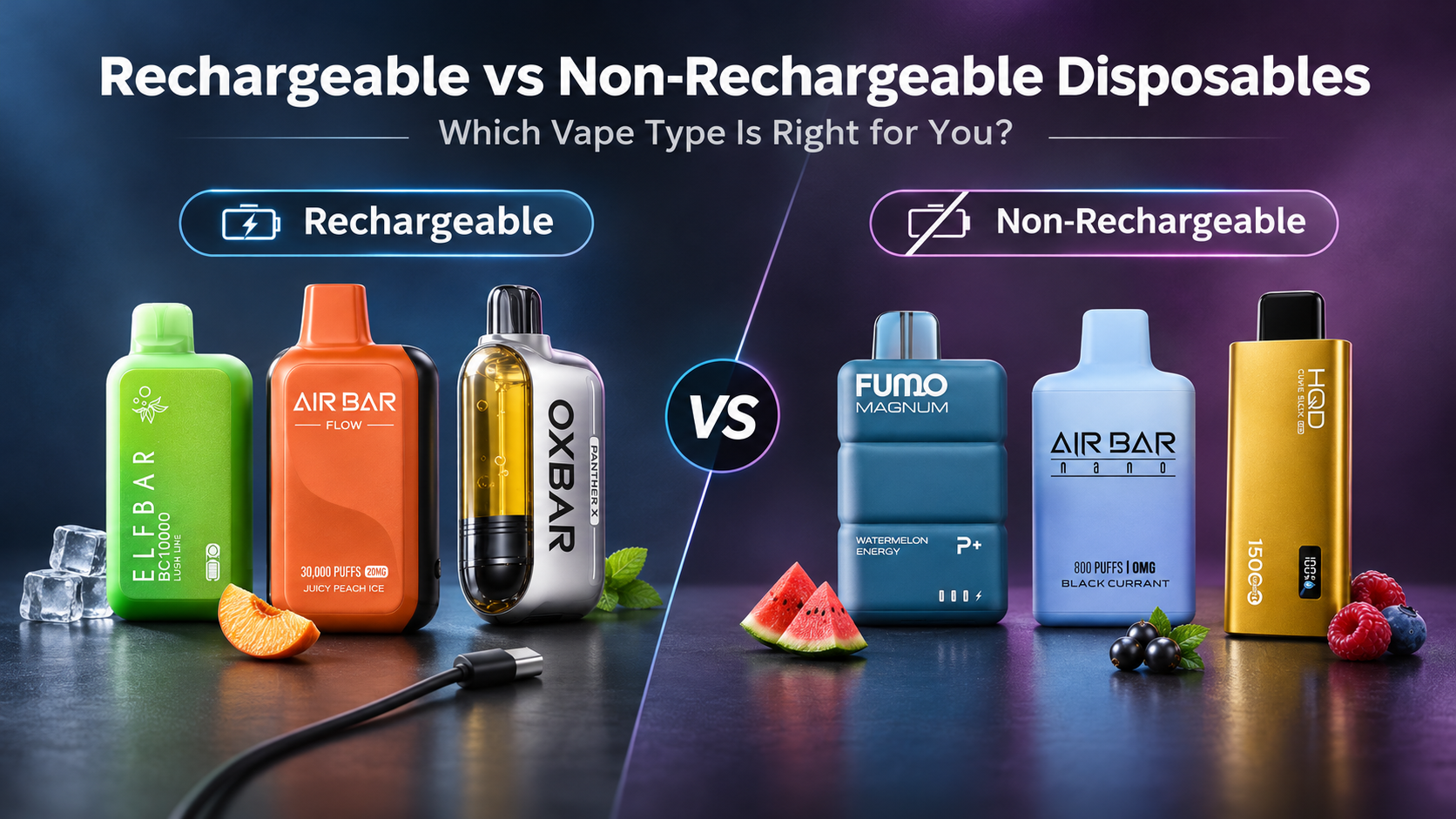
Not sure whether to choose a rechargeable or non-rechargeable disposable vape? Different battery capacities, e-liquid volumes, and puff ratings can make it difficult to compare devices and understand how long they may last.
This guide to rechargeable vs. non-rechargeable disposable vapes explains how each type works and what its specifications mean. You’ll learn how to identify rechargeable models, understand battery and e-liquid capacity, and compare puff ratings before choosing a device.
What Is a Rechargeable Disposable Vape?
A rechargeable disposable vape comes prefilled with e-liquid and has a built-in battery you can recharge when its power runs low. This allows you to continue using the device if the battery runs out before the e-liquid is finished.
However, recharging the battery does not make the device refillable. The e-liquid reservoir remains sealed, and once the liquid runs out, charging the battery will not restore the device.
What Is a Non-Rechargeable Disposable Vape?
A non-rechargeable disposable vape has a built-in battery that cannot be charged again. It works using the power stored in the battery. Once that power is used up, the device stops working, even if some e-liquid remains inside.
Rechargeable vs Non-Rechargeable Disposable Vapes: Key Differences
The main distinction is whether the battery supports recharging. Other features, including puff capacity and e-liquid capacity, depend on each model’s specifications.
| Feature | Rechargeable | Non-Rechargeable |
| Battery | Built-in battery that supports recharging. | Built-in battery that cannot be recharged. |
| Charging | Needs recharging when the battery runs low. | No charging needed. |
| E-Liquid Usage | Recharging may allow you to use the remaining e-liquid. | The battery may run out before the e-liquid is finished. |
| Puff Capacity | Often higher (5,000+ puffs). | Often lower (600–2,000 puffs). |
| End of Life | When the e-liquid is depleted or the device no longer functions. | When the battery or e-liquid runs out. |
| Best Suited For | Regular users. | Occasional users. |
Note: Puff counts are examples, not fixed limits. Both types are available in different capacities.
Battery Design and Charging Capabilities
Rechargeable disposable vapes have built-in batteries designed to accept an electrical charge. Depending on the model, the charging connection may use USB-C, Micro-USB or another specified connector.
Non-rechargeable models have batteries that are not designed to accept another charge. Their stored power supports operation until the battery is depleted.
A charging port alone does not confirm that a device is rechargeable. Check the manufacturer’s specifications and instructions before connecting a charging cable.
Battery Capacity and E-Liquid Capacity
Battery capacity and e-liquid capacity describe two different things. Manufacturers measure battery capacity in milliampere-hours (mAh)., while e-liquid capacity is measured in millilitres (ml).
- mAh: Indicates the battery’s charge capacity.
- ml: Indicates the volume of e-liquid the device holds.
For example, a device with a 1,000mAh battery has a higher rated battery capacity than one with a 700mAh battery. However, this does not automatically mean it will deliver more puffs or operate for longer.
Power consumption, operating voltage and device design all affect battery life. The battery and e-liquid can run out at different times, so either may be the reason the device stops working.
Puff Ratings and Actual Device Lifespan
Puff ratings indicate the estimated number of puffs a device may deliver under specific testing conditions. They are not guaranteed counts and cannot tell you exactly how many days a device will last.
Actual results depend on several factors:
- Length of each inhalation.
- Device power and heating system.
- Airflow settings, where available.
- Battery and e-liquid capacity.
- Manufacturer testing conditions.
A device may stop working before reaching its stated puff count if its battery or e-liquid runs out. Rechargeability alone does not guarantee a higher puff rating.
Which One Should You Choose?
A Rechargeable Model May Suit You If:
- You use a device regularly: You can recharge the battery when it runs low and continue using the device if e-liquid remains.
- You want more control over the device: Some models have digital displays, adjustable airflow and variable power settings.
- You are considering the cost over time: Compare the purchase price and stated puff capacity of different models to assess their relative value.
A Non-Rechargeable Model May Suit You If:
- You use a device infrequently: A non-rechargeable model may be worth considering if you do not need to recharge its battery.
- You have a limited upfront budget: Some non-rechargeable models cost less initially than rechargeable alternatives, depending on the device.
- You prefer a simpler design: Certain models operate through inhalation and have no additional buttons or adjustable power settings.
How to Identify a Rechargeable Disposable Vape
A disposable vape is rechargeable if its manufacturer confirms that the built-in battery can be recharged. Check the exact model’s packaging, official product specifications or user manual to verify its charging capability.
Consider these four details:
- Rechargeable label: Look for a clear statement such as “rechargeable battery” or “rechargeable device”.
- Battery capacity: A rating in milliampere-hours (mAh) indicates the battery’s charge capacity. It does not necessarily mean that the battery can be recharged.
- Charging Port: Verify whether the manufacturer specifies that the port is intended for recharging the battery.
- Charging instructions: Follow the manufacturer’s recharging guidance and safety precautions.
Always verify the exact model and version because similar-looking devices may have different charging features.
How to Charge a Rechargeable Disposable Vape
To charge a rechargeable disposable vape, connect the correct Micro-USB or USB-C cable to the device’s charging port. Plug the other end into a suitable power source, following the manufacturer’s charging recommendations.
Keep these points in mind:
- Use the charger and charging input recommended by the manufacturer.
- Do not charge a damaged device or one with a damaged charging port.
- Stop charging immediately if the device gets excessively hot or displays any signs of damage.
- Never leave the device unattended while charging or allow it to charge overnight.
- Do not attempt to recharge a model that is not designed to be rechargeable.
Frequently Asked Questions
Can a Disposable Vape Be Rechargeable?
Yes. Some disposable vapes have built-in rechargeable batteries that can be charged when depleted. Non-rechargeable models cannot be charged again.
Does a Higher mAh Battery Mean More Puffs?
Not necessarily. A higher mAh rating means greater battery capacity, but puff count also depends on e-liquid capacity and how much power the device uses.
Can a Rechargeable Disposable Vape Run Out of E-Liquid Before Its Battery?
Yes. The e-liquid can run out before the battery is empty. Recharging the device restores battery power but does not refill the e-liquid.
Why Does a Disposable Vape Stop Working When It Still Has E-Liquid?
A disposable vape can stop working when its battery runs out before the e-liquid is used up. If the device is rechargeable, charging the battery may allow it to work again.
Does a Charging Port Mean a Disposable Vape Is Rechargeable?
No. A disposable vape with a charging port is not necessarily rechargeable. Only models designed with a rechargeable battery can be safely charged.
Are Rechargeable or Non-Rechargeable Batteries Better?
Neither is universally better. Rechargeable batteries can be charged again. Non-rechargeable batteries cannot be recharged once depleted.
Conclusion
You now understand how rechargeable and non-rechargeable disposable vapes differ, what battery capacity and e-liquid volume mean, and why puff ratings do not tell the whole story. Knowing these details helps you compare device specifications more accurately.
Before choosing a model, check its battery type, e-liquid capacity and stated puff count. Also, confirm the manufacturer’s charging instructions to find out whether the device supports recharging.