
Blog
How Long Does a Disposable Vape Last? Puff Count Explained

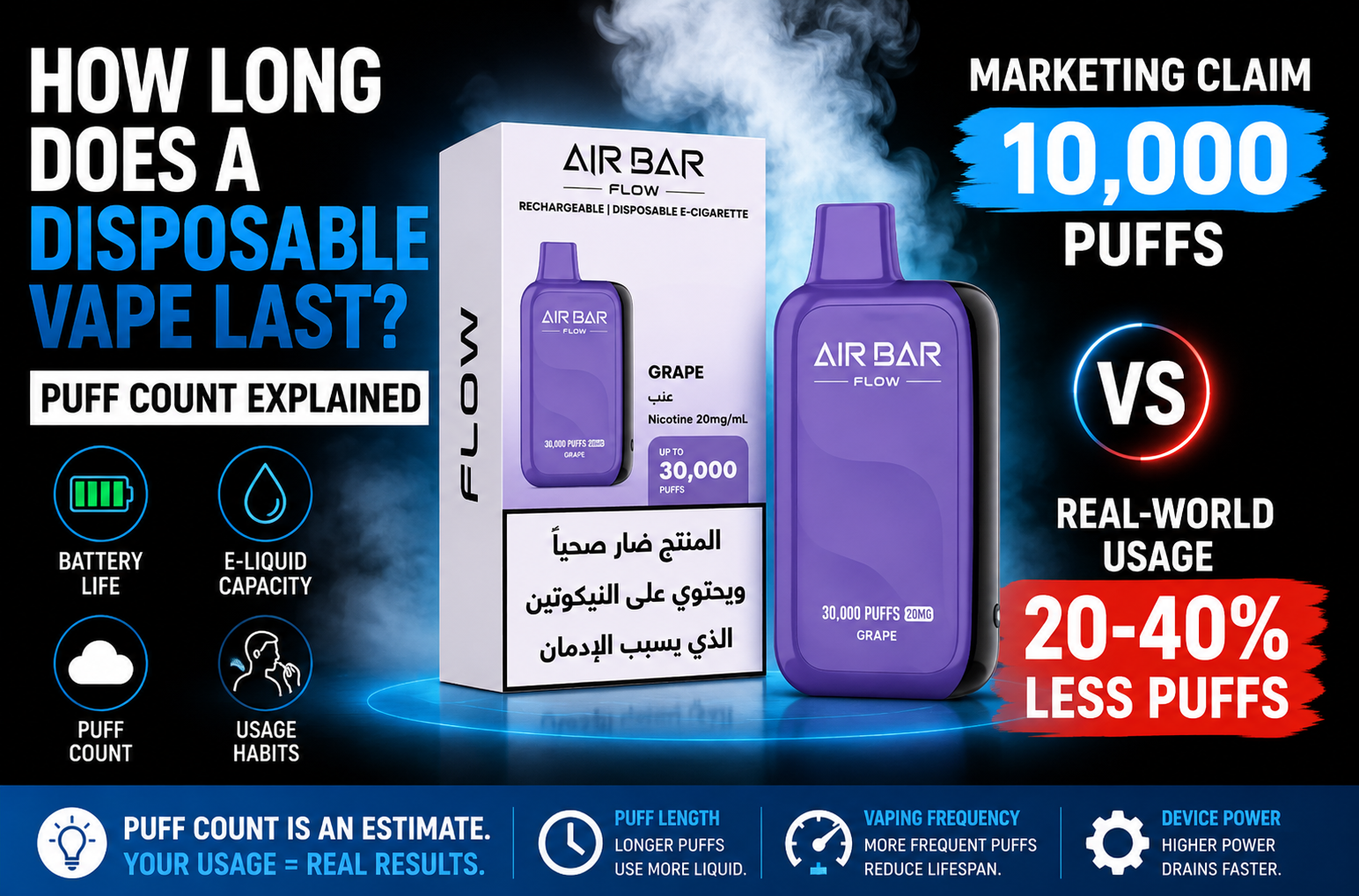
A disposable vape labelled “10,000 puffs” might sound like it will last for weeks. But how long it actually lasts depends on how often you use it, how long you inhale, and how the device performs.
Puff count is the manufacturer’s estimated number of inhalations a device can deliver under specific testing conditions. In everyday use, the actual number can be lower because puff duration, power settings, and usage patterns vary.
This guide explains how long a disposable vape lasts, what affects its puff count, and how to estimate its lifespan based on daily usage. Before getting into the numbers, it helps to understand what disposable vapes actually are and how they work. By the end, you’ll know how to interpret advertised puff counts without treating them as guaranteed results.
What Does Puff Count Actually Mean?
Manufacturers may estimate puff counts through controlled testing using automated equipment. These tests can involve repeated draws at specified durations and intervals, but testing methods vary between manufacturers and devices. As a result, the advertised number may not accurately reflect how many puffs someone gets during everyday use.
Disposable vapes are advertised with a wide range of puff counts. Examples include:
- 300–800 puffs: Lower-capacity devices
- 2,000–6,000 puffs: Devices advertised with medium-range puff capacities
- 10,000–20,000+ puffs: Higher-capacity devices, including some rechargeable models
These are illustrative ranges rather than standardized product categories. Actual performance depends on the device and how it is used.
Puff Count vs E-Liquid Capacity: What’s the Difference?
Puff count estimates how many inhalations a device may deliver, while e-liquid capacity measures how much liquid it contains, usually in millilitres (mL).
Two devices containing the same amount of e-liquid may advertise different puff counts because of differences in power output, airflow, coil design, and testing conditions.
For example, two devices containing 10 mL of e-liquid may not deliver the same number of puffs. E-liquid volume is a physical measurement, while advertised puff count is an estimate influenced by how the device operates.
Why Your Vape Runs Out Sooner Than Expected
Puff length, frequent use, power settings, battery performance, coil design, and e-liquid composition can all affect how long a disposable vape lasts. Understanding how disposable vapes work internally makes it easier to see how these six factors influence actual puff count.
1. Puff Length
A one-second draw uses far less e-liquid than a four- or five-second drag. Lab testing assumes short draws. Most people take longer ones, which is the main reason real-world puff counts fall short of the number on the box.
2. Chain Vaping
Taking several puffs back-to-back keeps the heating element active more frequently and increases e-liquid consumption over a short period. Frequent use can also reduce the time available for e-liquid to reach the coil between draws, depending on the device’s design.
Even leaving around 30 seconds between draws can make a difference over the course of a day.
3. Power Mode Settings
Many modern disposables include a “boost” or “turbo” mode. Higher output produces thicker clouds, but it also burns through e-liquid faster.
4. Battery Quality
Battery performance can affect how much of a device’s e-liquid is usable. In a non-rechargeable disposable vape, the battery may become depleted while some liquid remains inside. Rechargeable disposable models work differently because their batteries can be recharged, although the device’s overall lifespan still depends on its components and remaining e-liquid.
If you want to understand the difference between these designs, compare rechargeable vs non-rechargeable disposables.
5. Coil Type
Coil design affects how e-liquid is heated and converted into aerosol. Mesh coils distribute heat across a larger surface area, but the amount of liquid consumed depends on factors such as power output, airflow, and puff duration. Coil type alone does not determine how many puffs a device will deliver.
6. E-Liquid Composition
E-liquid typically contains different proportions of vegetable glycerin (VG) and propylene glycol (PG). These ingredients influence the liquid’s thickness and aerosol characteristics. However, their effect on puff count depends on the device’s heating system, power output, and usage conditions rather than the VG or PG ratio alone.
How Long Will a Disposable Vape Actually Last?
The honest answer depends on how much you vape each day.
Advertised Puff Count | Light Use (100–200 puffs/day) | Moderate Use (300–500 puffs/day) | Heavy Use (600–1,000 puffs/day) |
2,000 puffs | 10–20 days | 4–7 days | 2–3 days |
5,000 puffs | 25–50 days | 10–17 days | 5–8 days |
10,000 puffs | 50–100 days | 20–33 days | 10–17 days |
15,000 puffs | 75–150 days | 30–50 days | 15–25 days |
Note: These are theoretical estimates calculated using the full advertised puff count. They are not measured product lifespans or guaranteed results. Actual lifespan may be shorter depending on draw length, power settings, battery performance, and e-liquid consumption.
Are Puff Counts Regulated or Standardised?
There is no single internationally standardized testing method that guarantees the accuracy of advertised disposable vape puff counts.
In Dubai and across the United Arab Emirates (UAE), electronic nicotine products are regulated under UAE.S 5030:2018, a mandatory standard covering product safety, electronic nicotine products, e-liquid requirements, and packaging and labelling.
The UAE Ministry of Industry and Advanced Technology (MoIAT) provides information about the country’s regulatory requirements for electronic nicotine products.
However, these regulatory requirements should not be interpreted as a guarantee that every advertised puff count reflects an exact number of puffs.
Actual puff counts can vary depending on individual puff duration, device performance, battery capacity, and usage patterns.
For consumers in Dubai and throughout the UAE, advertised disposable vape puff counts should therefore be understood as estimates rather than guaranteed measurements. Consumers should also check applicable UAE regulations and product information before making purchasing decisions.
How to Choose the Right Puff Count for Your Habits
Understanding the relationship between advertised puff count and daily usage makes it easier to estimate how long a device may last. However, puff ratings alone cannot establish a device’s actual lifespan, safety, or suitability.
Light usage (100–200 puffs per day): At this rate, a device delivering 2,000 usable puffs would theoretically last 10–20 days.
Moderate usage (300–500 puffs per day): A device delivering 5,000 usable puffs would theoretically last approximately 10–17 days.
Frequent usage (600–1,000 puffs per day): A device delivering 10,000 usable puffs would theoretically last approximately 10–17 days.
These examples illustrate how daily puff frequency affects estimated lifespan. They do not establish how many puffs a particular person should take or which device is appropriate for them.
Actual results depend on the device’s performance and individual usage patterns. Nicotine-containing products are addictive, and people who do not already use tobacco or nicotine should not start vaping.
When a Higher Puff Count Is Not Worth It
A higher advertised puff count does not always mean a device will last proportionally longer or provide better value. Actual lifespan depends on usable e-liquid, battery performance, power settings, and individual usage patterns.
High-capacity disposable vapes may contain more e-liquid, larger batteries, or additional electronic components, depending on their design. However, two devices with different advertised puff counts cannot be reliably compared using those numbers alone.
Storage conditions and product design can also affect performance over time. E-liquid quality and battery condition may change during prolonged storage, although the rate of change varies between products.
There are environmental considerations as well. Disposable vapes contain electronic components and batteries that require appropriate disposal. Their environmental impact depends on factors such as materials, product design, collection systems, and recycling practices.
A higher puff-count rating should therefore be understood as a manufacturer’s estimate, not automatic evidence of longer lifespan, lower cost, or reduced environmental impact.
FAQ
Why does my disposable vape taste burnt before it runs out?
This usually means the coil is firing without enough e-liquid reaching it. It can happen when the device is running low, when you chain vape, or when the device is held at an angle that keeps liquid away from the coil. Take slower draws and leave a few seconds between puffs.If you’re new to vaping, our guide on using a disposable vape for the first time covers these common beginner mistakes in detail.
Can a 10,000-puff vape really deliver that many puffs?
Yes, under controlled conditions. A moderate user taking short draws without boost mode may get close to the stated count. Heavy daily users taking long draws will often receive far fewer puffs.
Is puff count the best way to compare disposable vapes?
No. It is only one factor. Battery capacity, e-liquid volume, nicotine strength, coil type, power settings, and brand reputation can matter just as much.
Do all disposable vapes contain nicotine?
Most do. Nicotine-free versions exist, but they make up a smaller share of the market. Always check the packaging, as nicotine content is required to be listed in many markets.
Are disposable vapes suitable for someone who has never smoked?
No. Disposable vapes, like all nicotine products, are intended for adult smokers seeking an alternative not for people who have never used tobacco or nicotine products.
Final Thoughts
Puff count is a starting point, not a deadline. The number on the box tells you roughly how two devices compare; it does not tell you exactly how many days the device will last.
What actually determines lifespan is how long your draws are, how often you vape, and whether you use higher-power modes. Match the device to your real habits, not the highest number on the shelf.
If your device consistently runs out earlier than expected, the answer is not always a higher puff count. Start by estimating your daily usage and comparing it with the device’s advertised rating. Use the result as a rough lifespan estimate, keeping in mind that real-world performance can differ from the number on the box.