
Blog
PG vs VG in E-Liquid: What’s the Difference and Why Does It Matter?

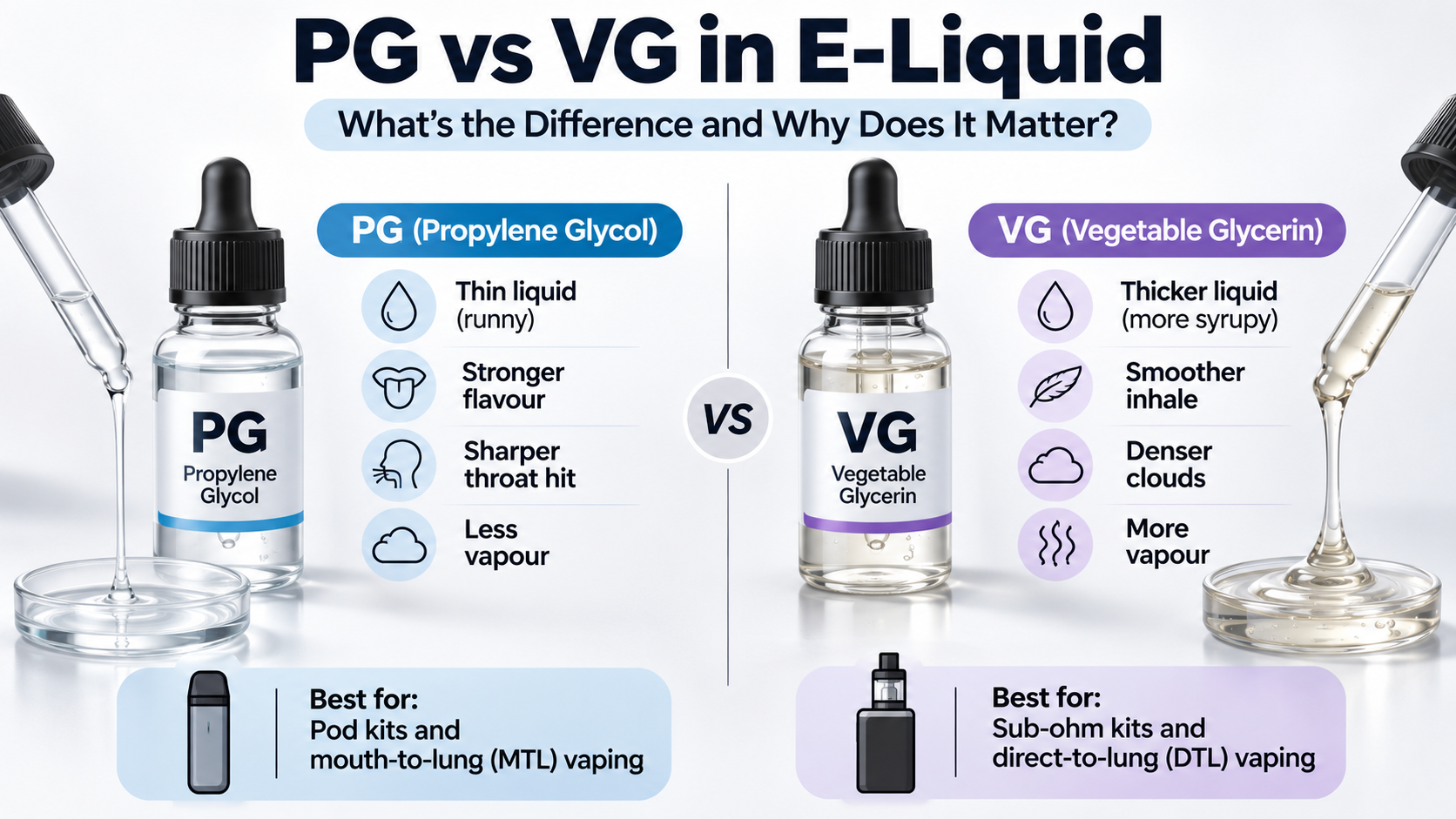
Choosing the wrong e-liquid ratio can leave you dealing with leaks, weak flavour, or an unpleasant burnt taste. Understanding PG vs VG in e-liquid helps explain how different blends affect your vaping experience.
In this guide, you’ll learn the differences between propylene glycol and vegetable glycerin, how common PG/VG ratios work, and why matching e-liquid thickness to your device matters.
TL;DR
- PG (propylene glycol) = thin liquid, stronger throat hit, sharper flavour, less vapour. Best for pod kits and mouth-to-lung (MTL) vaping.
- VG (vegetable glycerin) = thick liquid, smoother inhale, denser clouds, softer flavour. Best for sub-ohm and direct-to-lung (DTL) vaping.
- 50% PG / 50% VG is commonly used in many refillable pod kits, while 30% PG / 70% VG is commonly used in sub-ohm devices. These are general examples, not universal compatibility rules.
- Match the ratio to your coil first, your preferred inhale second. Wrong ratio → leaking, dry hits, or burnt taste, regardless of which one “sounds better” to you.
What Are PG and VG in Vape Juice?
Propylene glycol (PG) and vegetable glycerin (VG) are common ingredients in e-liquid.
Together, they carry flavourings and, where included, nicotine. In turn, their ratio affects the thickness of the liquid, flavour intensity, throat hit, vapour production, and device compatibility.
A bottle labelled 50/50 PG/VG, for example, contains an equal balance of propylene glycol and vegetable glycerin. By contrast, a 70/30 VG/PG liquid contains more vegetable glycerin and produces a different vaping experience.
What Is PG in Vape Juice?
Propylene glycol is a thin, colourless liquid that carries flavour well and creates a more noticeable throat hit. E-liquids with a higher PG content are commonly used in pod systems, starter kits, and mouth-to-lung devices.
PG has a light consistency, so it moves through small coil openings and cotton more easily than thicker e-liquids.
PG Produces a Stronger Throat Hit
Higher-PG e-liquids usually create a sharper sensation at the back of the throat. Some former smokers prefer this feeling because it can resemble the throat hit produced by cigarette smoke.
However, nicotine level, airflow, power output, and flavour type are also among the causes of a harsh throat hit. PG is only one part of the overall experience.
PG Carries Flavour More Effectively
PG is widely used in e-liquid because it holds and delivers flavour efficiently. As a result, a higher-PG blend may make certain flavours feel stronger, clearer, or more defined.
This can be useful for vapers who prioritise flavour over large vapour clouds.
PG Has a Thinner Consistency
Because PG is thinner than VG, it is easier for smaller coils to absorb. This difference in how PG and VG affect liquid thickness also makes higher-PG and 50/50 liquids suitable for many low-powered pod kits and starter devices.
However, a very thin liquid may leak when used in a powerful device designed for thicker, high-VG blends.
What Is VG in Vape Juice?
Vegetable glycerin is a thick, slightly sweet liquid that produces dense vapour and a smoother inhale. For this reason, high-VG e-liquids are often used in sub-ohm kits and direct-to-lung devices.
VG is heavier than PG, so it requires a coil that can absorb thicker liquid efficiently.
VG Produces Larger Vapour Clouds
The main advantage of VG is vapour production. E-liquids with a high VG content create thicker and more visible clouds than high-PG blends.
As a result, high-VG liquids are popular with direct-to-lung users and people who prefer a cloud-focused vaping style.
VG Creates a Smoother Inhale
VG usually feels softer on the throat than PG. A higher-VG blend may therefore suit people who find strong throat hits uncomfortable.
However, the inhale can still feel warm or intense when used at high wattage, so device settings also matter.
VG Has a Thicker Consistency
High-VG e-liquid moves more slowly through coil cotton. Therefore, it works best with coils that have larger wicking openings and enough power to vaporise the liquid properly.
By contrast, using a thick e-liquid in a small pod may cause poor wicking, reduced flavour, or dry hits.
What Is the Difference Between PG and VG?
The main difference between PG and VG is how they affect flavour, throat hit, vapour production, liquid thickness, and device performance.
| Feature | PG: Propylene Glycol | VG: Vegetable Glycerin |
|---|---|---|
| Consistency | Thin and runny | Thick and syrup-like |
| Flavour delivery | Stronger and more defined | Softer and slightly sweeter |
| Throat hit | Sharper and more noticeable | Smoother and gentler |
| Vapour production | Smaller clouds | Larger, denser clouds |
| Best suited to | Pod kits and mouth-to-lung devices | Sub-ohm and direct-to-lung devices |
| Wicking speed | Faster | Slower |
| Leakage risk | Higher in powerful devices | Lower when matched with suitable coils |
Neither ingredient is automatically better. The right choice depends on your device, coil resistance, nicotine strength, airflow, and personal preference.
Common PG/VG Ratios Explained
Most e-liquids contain a mixture of PG and VG rather than using only one base ingredient. Different types of e-liquid contain varying blends, and the most suitable ratio largely depends on the device you use.
50/50 PG/VG E-Liquid
A 50/50 e-liquid offers an even balance of flavour, throat hit, vapour, and liquid thickness. It is one of the most common choices for beginners and pod-kit users.
This ratio works well in many low-powered devices because it is thin enough to wick through smaller coils without producing an excessively harsh or cloud-heavy vape.
Who should choose a 50/50 blend?
- You use a refillable pod system or a beginner-friendly vaping device.
- Mouth-to-lung vaping is your preferred style.
- A balance of flavour and vapour is important to you.
- You are unsure which ratio to try first.
- Your coil is designed for thinner e-liquids.
Always check the device or coil instructions before choosing a liquid.
70/30 VG/PG E-Liquid
A 70/30 VG/PG blend consists of 70% vegetable glycerin and 30% propylene glycol. It produces more vapour, a smoother inhale, and a thicker liquid consistency.
This ratio is commonly used with sub-ohm coils and higher-powered vape kits.
Who should choose a 70/30 blend?
- You use a sub-ohm device.
- Direct-to-lung vaping is your preferred style.
- Larger vapour clouds are important to you.
- You prefer a smoother throat feel.
- Your coil has large wicking openings.
However, a 70/30 blend may not wick properly in compact pod systems designed for 50/50 liquids.
High-PG E-Liquid
High-PG e-liquids contain more propylene glycol than vegetable glycerin. They usually deliver a stronger throat hit, clearer flavour, and less vapour.
These blends are less common than 50/50 and high-VG liquids, but they may suit low-powered devices and users who prefer a cigarette-like inhale.
However, high-PG e-liquid can feel harsh when combined with strong nicotine, high wattage, or restricted airflow.
High-VG E-Liquid
High-VG e-liquid normally contains 70% VG or more. It is designed for devices that can handle thick liquid and produce high volumes of vapour.
However, these blends are not ideal for every device. Small coils may struggle to absorb them quickly enough, particularly during repeated use.
How Popular Commercial Products Actually Ratio Their Liquid
Manufacturers rarely publish exact formulas, but independent lab analysis and brand specification sheets give a useful real-world reference point:
| Product type | Typical PG/VG ratio | Source |
|---|---|---|
| JUUL-style nicotine salt pods | ~30% PG / 70% VG | Independent GC-MS lab analysis of commercial pods<cite index=”18-1″>found the liquid and aerosol PG/VG ratio to be 30/70</cite> |
| Freebase bottled e-liquid (typical retail brand) | 70% VG / 30% PG | Brand specification, e.g. <cite index=”16-1″>Skwezed Freebase e-liquids use a 70/30 VG/PG ratio</cite> |
| Nicotine salt bottled e-liquid (typical retail brand) | 50% VG / 50% PG | Brand specification, e.g. <cite index=”16-1″>Skwezed Salt Nic e-liquids use a 50/50 VG/PG ratio</cite> |
| DIY/community baseline for refilling pod-style devices | 60/40 to 70/30 PG/VG (device-dependent) | Community consensus among DIY mixers |
Takeaway: high-nicotine, low-wattage closed-pod systems tend to skew VG-heavy despite being “MTL” devices, because their tight coil and high nicotine concentration affect how the liquid moves through the coil. Don’t assume “pod = high PG” — check the specific product’s listed ratio, not just its device category.
Which PG/VG Ratio Should You Choose?
Choose your PG/VG ratio based on your device first and your preferred vaping experience second. A liquid that does not suit your coil can leak, burn poorly, or produce weak flavour.
Use the following guide as a starting point.
Choose higher PG when you want:
- A stronger throat hit.
- More noticeable flavour.
- Less vapour.
- A thinner e-liquid.
- A mouth-to-lung vaping style.
- Compatibility with many starter kits and pod systems.
Choose higher VG when you want:
- A smoother inhale.
- Larger vapour clouds.
- A thicker e-liquid.
- A direct-to-lung vaping style.
- Compatibility with sub-ohm coils and high-powered devices.
Choose 50/50 when you want:
- A balance between PG and VG.
- Moderate vapour production.
- Clear flavour without an extreme throat hit.
- A beginner-friendly option.
- An e-liquid suitable for many refillable pod kits.
When in doubt, check the recommended e-liquid ratio for your coil rather than guessing.
How Do PG and VG Affect Vape Devices?
PG and VG affect how quickly e-liquid moves through the coil and how efficiently it vaporises. Thin liquids work better in some devices, while thick liquids need larger coils and more power.
Matching the liquid to the device helps reduce leaking, dry hits, poor flavour, and premature coil damage.
PG/VG Ratios for Pod Kits
Most low-powered pod kits work best with 50/50 or moderately high-PG liquids. Their smaller coils and narrow wicking ports are designed to absorb thinner liquid.
Using a very thick high-VG e-liquid may cause the cotton to dry out between puffs.
PG/VG Ratios for Sub-Ohm Kits
Sub-ohm kits usually work best with 70/30 or other high-VG blends. Their larger coils, wider airflow, and higher power output are designed to vaporise thicker liquids.
A thin, high-PG liquid may leak through a sub-ohm coil or create an overly harsh inhale.
Does Coil Resistance Matter?
Coil resistance can help indicate which liquid to use, but it should not be treated as the only rule. Coil design, power range, cotton density, airflow, and wicking-port size also affect compatibility.
As a general guide, higher-resistance mouth-to-lung coils often suit 50/50 liquids. Lower-resistance direct-to-lung coils are more likely to suit high-VG blends.
Always follow the coil manufacturer’s recommendation where one is provided.
What Happens If You Use the Wrong PG/VG Ratio?
Using the wrong ratio can affect both performance and comfort. The most common problems are leaking, burnt tastes, weak vapour, flooding, and excessive throat irritation.
Signs Your E-Liquid Is Too Thick
Your liquid may be too high in VG when:
- The coil produces dry or burnt hits.
- Flavour becomes weak after several puffs.
- Cotton takes a long time to absorb the liquid.
- Your device struggles during frequent use.
- The coil burns out unusually quickly.
These problems occur because the thick liquid cannot reach the heating element fast enough.
Signs Your E-Liquid Is Too Thin
Your liquid may be too high in PG when:
- The pod or tank leaks frequently.
- Flooding or gurgling occurs in the coil.
- E-liquid enters the mouthpiece.
- The throat hit feels too sharp.
- Vapour production is lower than expected.
A thinner liquid can move through large coil openings too quickly.
Does PG or VG Affect Flavour?
PG generally delivers stronger and more accurate flavour, while VG creates a softer and slightly sweeter taste. However, the difference may be subtle in a well-formulated e-liquid.
In addition, flavour intensity depends on the flavour concentrate, coil condition, airflow, wattage, and device design. Changing the PG/VG ratio will not always fix a weak-tasting liquid.
Does PG or VG Affect Nicotine Strength?
The PG/VG ratio does not change the nicotine amount printed on the bottle. However, it can change how strong the nicotine feels during inhalation.
A higher-PG liquid may make the throat feel sharper. By contrast, a high-VG liquid may feel smoother, even when the labelled nicotine strength is the same.
In addition, device power matters. High-powered devices produce more vapour per puff, which can increase nicotine intake.
Are PG and VG Safe to Vape?
PG and VG are commonly used in foods, cosmetics, medicines, and vape liquids. Although regulators generally consider these ingredients safe to consume, this does not mean they are proven safe to inhale. When heated inside a vape device, PG and VG can create substances with a different health risk profile, and the long-term effects of repeatedly inhaling them are still not fully understood. For example, some people may experience a dry mouth, coughing, throat irritation, or breathing discomfort, especially when using vape juice with a higher PG level. Stop vaping and seek medical advice if you develop persistent irritation, chest pain, breathing problems, or other concerning symptoms. People who do not already smoke or use nicotine should not start vaping. This information is for general education only and should not replace professional medical advice.
PG vs VG: Quick Decision Guide
The easiest way to choose is to match the ratio to your device and preferred inhale.
- Choose 50/50 PG/VG for most starter kits, refillable pods, and mouth-to-lung devices.
- For sub-ohm kits, direct-to-lung vaping, and larger vapour clouds, choose 70/30 VG/PG.
- For stronger flavour and throat hit, a higher-PG blend is an option, provided your device supports thinner liquids.
- A higher-VG blend is an option for smoother inhales and more vapour, provided your coil can wick thick e-liquid properly.
Not sure which ratio your device needs? Check your coil’s printed resistance (ohm rating) and cross-reference it with your device manufacturer’s recommended e-liquid guidance before you buy — this single check prevents the majority of leaking and dry-hit complaints covered above.
Frequently Asked Questions About PG and VG
What Are PG and VG in Vape Juice?
PG and VG are the two main base liquids used in e-liquid. PG carries flavour and creates throat hit, while VG produces thicker vapour and a smoother inhale.
As a result, their ratio affects how the liquid tastes, feels, and performs inside a vape device.
Which Is Better: PG or VG?
Neither PG nor VG is better for everyone. PG is better suited to people who prefer stronger flavour and throat hit, while VG is better suited to people who prefer smoother inhales and larger vapour clouds.
The best ratio is the one that matches your device and vaping style.
Is 50/50 PG/VG Good for Beginners?
A 50/50 blend is often a practical starting point for beginners using pod kits or starter devices. It offers a balanced combination of flavour, throat hit, vapour, and wicking performance.
Check that your coil is designed for 50/50 e-liquid before use.
Can I Use 70/30 E-Liquid in a Pod Kit?
You should only use 70/30 e-liquid in a pod kit if the manufacturer confirms that the coil can handle high-VG liquid. In fact, many compact pods have small wicking openings that struggle with thick blends.
As a result, using 70/30 liquid in an unsuitable pod may lead to weak flavour, dry hits, or a burnt coil.
Can I Use 50/50 E-Liquid in a Sub-Ohm Tank?
Some sub-ohm tanks can use 50/50 liquid, but thinner e-liquid may leak through coils designed for high-VG blends. Furthermore, it may feel harsher because sub-ohm devices produce more vapour per puff.
Check the coil guidance before filling the tank.
Can You Mix PG and VG Yourself?
PG and VG can be mixed when making DIY e-liquid, but accurate measurements are essential. Nicotine and flavour concentrates must also be handled carefully and kept away from children and pets.
Most users will find ready-made e-liquid simpler and more consistent.
Can PG Cause a Dry Throat?
PG can contribute to throat dryness or irritation in some users. Drinking water may help with mild dryness, but persistent symptoms should not be ignored.
Switching to a lower-PG blend may reduce irritation for some people.
Does More VG Mean Less Flavour?
High-VG e-liquid can sometimes produce a softer flavour than high-PG liquid. That does not necessarily mean the e-liquid will taste weak, because manufacturers often adjust the flavour concentration to suit the base ratio.
In fact, the device and coil can have as much impact on flavour as the PG/VG blend.
Final Thoughts on Choosing a PG/VG Ratio
The right PG/VG ratio should give you reliable coil performance and the type of inhale you prefer. In general, higher PG provides stronger flavour and throat hit, while higher VG delivers smoother inhales and denser vapour.
Start by checking which liquid your device supports. For many pod and starter-kit users, a 50/50 blend is the most practical choice, while sub-ohm users will usually get better results from a 70/30 VG/PG e-liquid.