
Blog
Freebase vs Salt Nic: Key Differences, Ingredients & Facts Explained

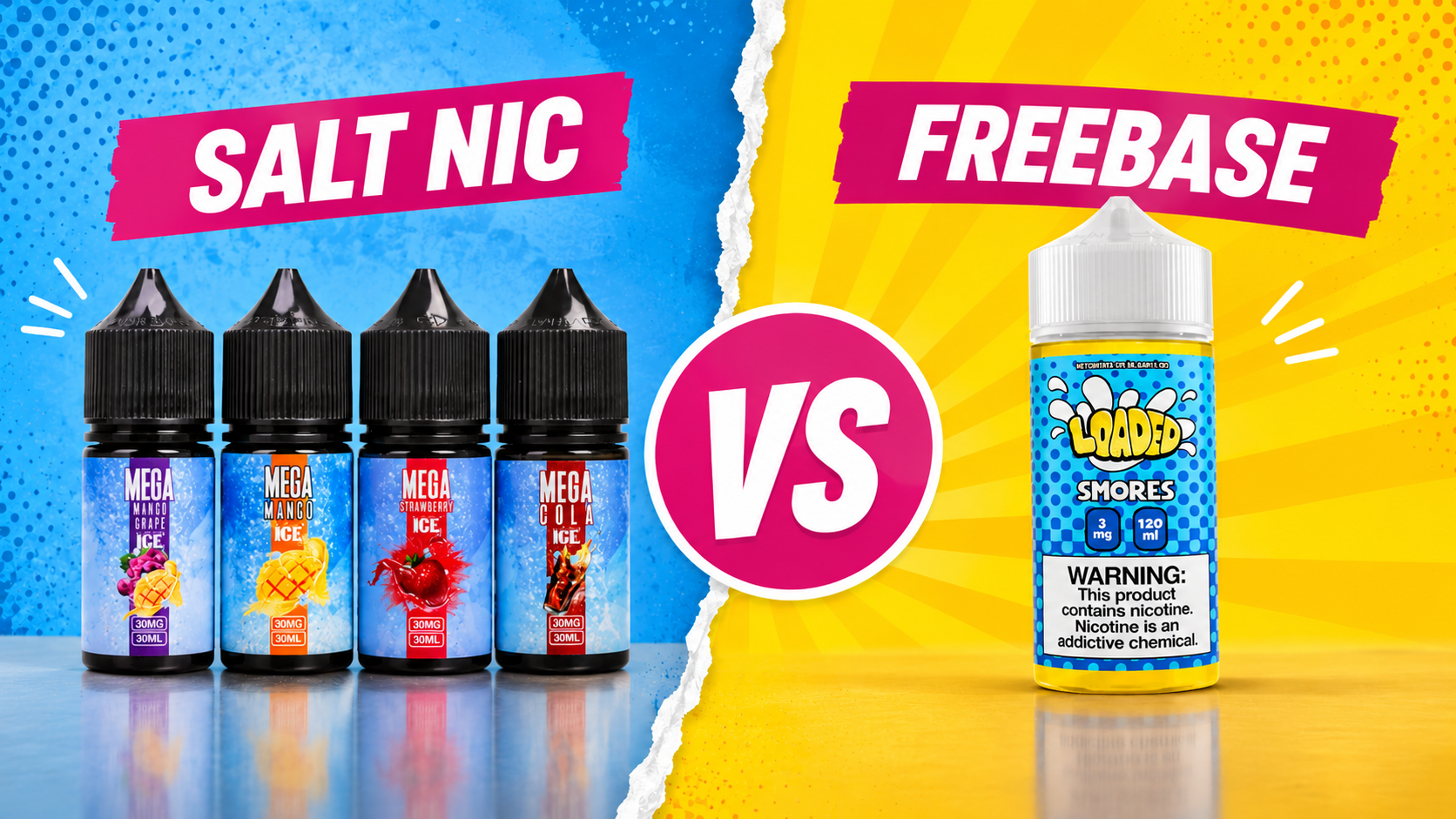
When comparing vaping liquids, two terms appear frequently: freebase nicotine and nicotine salts. Although both contain nicotine, their chemical formulations can affect throat sensation, nicotine delivery, and how they perform in different devices.
The main difference in freebase vs salt nic is their chemical form. Freebase nicotine is predominantly unprotonated, while nicotine salts contain protonated nicotine formed through reactions with acids. This guide explains their ingredients, strengths, absorption, device compatibility, and health considerations.
What Is Freebase Nicotine?
Freebase nicotine is a form of nicotine that exists primarily in its unprotonated, or base, form. It has been widely used in e-liquids and is associated with a more noticeable throat sensation at higher concentrations.
Freebase nicotine formulations generally have a higher pH than comparable nicotine salt formulations. However, the exact pH and sensory effects depend on the complete e-liquid composition.
What Is Salt Nicotine (Nic Salt)?
Salt nicotine, commonly called nic salt, is a protonated form of nicotine produced when nicotine reacts with an acid. Benzoic acid is one example used in commercial nicotine salt formulations.
Nicotine salts can reduce the harsh throat sensation associated with certain higher-concentration freebase formulations. This does not mean they contain less nicotine or pose fewer health risks.
Despite the name, nicotine salt does not mean that ordinary table salt has been added to the e-liquid.
Freebase vs Salt Nic: Key Differences
Freebase nicotine and nicotine salts differ mainly in chemical form, formulation pH, and throat sensation. Nicotine delivery also varies, but it depends on factors beyond nicotine type, including concentration, device design, and user behavior.
| Feature | Freebase Nicotine | Salt Nicotine |
| Chemical form | Predominantly unprotonated | Predominantly protonated |
| Formulation pH | Generally higher | Often lower |
| Added acids | Not required for nicotine salt formation | Commonly includes organic acids |
| Throat hit | Often more noticeable at comparable strengths | Often smoother at comparable strengths |
| Nicotine strength | Varies by product | Varies by product |
| Absorption | Depends on formulation and device | Depends on formulation and device |
| Flavor | Influenced by the full formulation | Influenced by the full formulation |
| Vapor production | Primarily device- and formulation-dependent | Primarily device- and formulation-dependent |
| Common devices | Various refillable systems | Often found in pod systems |
| Health risks | Nicotine dependence and aerosol exposure | Nicotine dependence and aerosol exposure |
These are general formulation differences rather than fixed rules for every product.
Freebase vs Salt Nic Ingredients Explained
Both freebase and nicotine salt e-liquids commonly contain nicotine, propylene glycol (PG), vegetable glycerin (VG), and flavoring ingredients. The main formulation difference is the use of an acid to produce protonated nicotine in nicotine salt products.
What Ingredients Are Used in Freebase E-Liquids?
Common ingredients include:
- Freebase nicotine: The predominantly unprotonated nicotine component.
- Propylene glycol (PG): A liquid carrier that helps distribute ingredients.
- Vegetable glycerin (VG): A liquid carrier that contributes to aerosol formation.
- Flavorings: Ingredients used to create specific flavors.
Ingredient lists vary by manufacturer, and some products contain additional substances.
What Ingredients Are Used in Nicotine Salt E-Liquids?
Nicotine salt formulations commonly contain the same basic carriers and flavorings, alongside an acid used to form nicotine salts.
Benzoic acid is one example, although other acids may be used depending on the formulation. The acid changes the proportion of protonated nicotine and can influence pH and throat sensation.
The term salt refers to a chemical form of nicotine, not sodium chloride, which is the common table salt.
Nicotine Strength and Absorption: What’s the Difference?
Nicotine strength describes the concentration of nicotine in an e-liquid, usually expressed in milligrams per milliliter (mg/mL) or as a percentage.
For example, a liquid labeled 20 mg/mL contains a nominal nicotine concentration of 20 milligrams per milliliter. A concentration of 20 mg/mL is equivalent to approximately 2% nicotine when percentage labeling uses weight per volume.
Nicotine salts are frequently associated with higher-concentration pod products, but neither formulation is inherently stronger at the same labeled concentration.
Absorption is more complicated. Research indicates that nicotine delivery can vary considerably with product design, aerosol chemistry, puffing behavior, and nicotine concentration. It is therefore inaccurate to claim that all nicotine salts are absorbed faster than all freebase products.
Throat Hit, Flavor and Vapor Production
Throat hit is the feeling you get in your throat when inhaling an aerosol. Freebase formulations often produce a more pronounced sensation than nicotine salt formulations at comparable nicotine concentrations.
Nicotine salts may feel smoother because protonation and formulation pH influence sensory irritation. However, individual experiences differ.
Flavor and aerosol production are not determined by nicotine type alone. PG/VG ratios, flavoring compounds, coil characteristics, power settings, and airflow can all influence these properties.
A smoother sensation should not be interpreted as evidence of reduced nicotine exposure or improved safety.
Device Compatibility: Freebase vs Salt Nic
Both freebase and nicotine salt e-liquids appear in different electronic nicotine delivery systems. Compatibility depends on the product’s nicotine concentration, viscosity, and the device manufacturer’s specifications.
Nicotine salts are commonly associated with lower-powered pod systems, while freebase formulations are found across a wider variety of refillable devices.
Coil resistance, wattage, and aerosol output can affect nicotine delivery. Using an unsuitable liquid or configuration may increase the risk of excessive nicotine exposure or device malfunction.
Device labels and manufacturer instructions should be followed rather than assuming that every e-liquid works with every device.
Is Salt Nic Safer Than Freebase Nicotine?
There is insufficient evidence to conclude that nicotine salts are generally safer than freebase nicotine. Both formulations contain nicotine, an addictive substance, and both can expose users to potentially harmful chemicals through vaping aerosols.
Nicotine exposure can affect heart rate and blood pressure, and nicotine use is particularly concerning during adolescence and pregnancy.
Aerosols may also contain harmful substances generated during heating, depending on the liquid, device, and operating conditions.
According to the CDC’s information on e-cigarette health effects, e-cigarettes are not harmless. The long-term effects of vaping are still being studied.
Neither a lower pH nor a smoother throat sensation establishes that a nicotine product is safer.
Frequently Asked Questions
What is the main difference between freebase and salt nic?
Freebase nicotine is predominantly unprotonated, while nicotine salts contain protonated nicotine. This chemical difference can influence formulation pH, throat sensation, and nicotine delivery characteristics.
Is salt nic stronger than freebase?
Not necessarily. Nicotine strength depends on concentration, not simply chemical form. However, nicotine salt formulations are commonly found in products with relatively high nicotine concentrations.
Does salt nic contain real salt?
Nicotine salts are chemical salts formed through acid-base reactions. They do not inherently contain sodium chloride, the substance commonly known as table salt.
Is nicotine salt absorbed faster than freebase?
Not always. Nicotine absorption depends on concentration, formulation, aerosol properties, device characteristics, and usage patterns. Results from one product cannot automatically be applied to every nicotine salt formulation.
Can you use salt nic and freebase in the same device?
Some devices can accommodate different e-liquid formulations, but compatibility is not universal. Nicotine concentration, liquid viscosity, coil specifications, and manufacturer instructions must be considered.
Conclusion
Understanding freebase vs salt nic begins with their chemistry. Freebase nicotine is predominantly unprotonated, whereas nicotine salts contain protonated nicotine formed through reactions with acids.
These differences can affect pH and throat sensation, but nicotine strength, absorption, flavor, and aerosol production also depend on the complete formulation and device.
When evaluating nicotine products, check ingredient disclosures, concentration labels, and credible health information. Neither formulation is risk-free, and people who do not use nicotine should not start.