
Blog
How Do Disposable Vapes Work? A Simple Guide

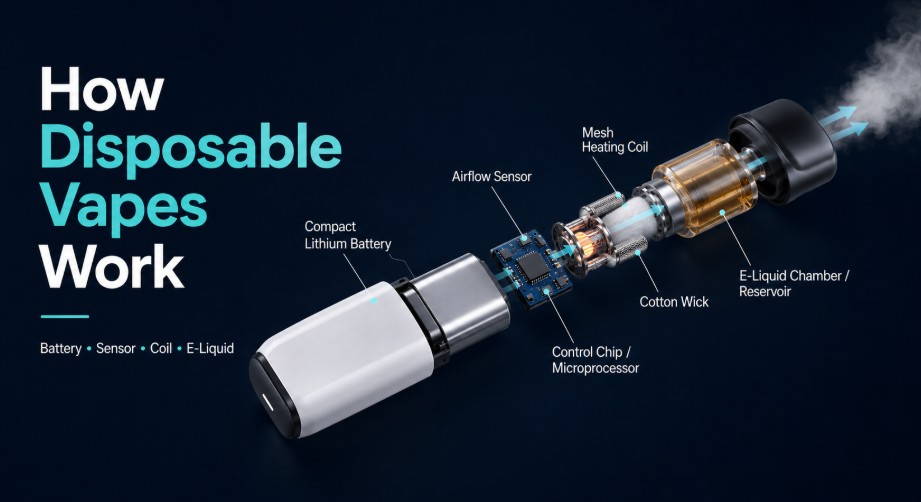
A disposable vape may look like a simple device, but several internal components work together every time someone inhales. Understanding how disposable vapes work helps explain what happens inside the device, from battery activation to aerosol production.
This guide explains how a disposable vape uses its battery, airflow sensor, heating coil, wick, and e-liquid to produce an aerosol. You’ll also learn what each component does, why these devices cannot normally be refilled, how long they last, and how to dispose of them responsibly.
A disposable vape works by heating liquid into an aerosol, whereas cigarettes generate smoke through tobacco combustion.Instead, it warms e-liquid into a fine aerosol that travels through the mouthpiece when you inhale.
How Does a Disposable Vape Work?
When you inhale from a disposable vape, it triggers a quick electrical process that activates the device and produces an aerosol.
- You inhale through the mouthpiece.
The airflow changes inside the device. - An airflow sensor detects the draw.
The airflow sensor signals the device’s control circuit to switch on when a user inhales.. - The control chip draws power from the battery.
It delivers a regulated flow of electrical power to the heating component. - The coil or mesh heats up.
The wick absorbs the e-liquid and keeps it in contact with the heating element. - The e-liquid becomes an aerosol.
This aerosol moves through the internal airflow channel and out through the mouthpiece. - The device stops operating once you finish inhaling.Its built-in sensor detects when you stop drawing air and switches off the heater, helping preserve battery life and prevent excess heat from building up..
These steps occur within seconds, allowing disposable vapes to function with minimal effort from the user.
What Powers a Disposable Vape?
The power source is usually a compact lithium-ion battery. Despite its compact size, it uses battery chemistry similar to that found in rechargeable devices such as smartphones, wireless earbuds, and laptops.
Battery capacity plays a key role in determining how long a device lasts, but several other factors also affect its operating time. Lifespan also depends on:
- The amount of e-liquid stored inside
- The heating power of the coil or mesh
- Puff length and frequency
- Airflow design
- Battery condition
Smaller disposables may have a non-rechargeable battery. Larger products often include a USB charging port, allowing the battery to be recharged until the internal liquid supply is exhausted.
Recharging only restores the battery’s power; it doesn’t replenish or increase the e-liquid inside the device. Once the liquid supply runs out, recharging the battery will not make the device usable again.
What Does the Coil Do?
The coil is the part responsible for heating the e-liquid. Some devices use a standard wire coil, while others feature a metal mesh that distributes heat across a wider area.
The heating component is surrounded by an absorbent wick, commonly made from cotton-based material. It draws e-liquid from the reservoir and keeps it in contact with the heated surface.
You can think of the wick as a small sponge that absorbs e-liquid from the reservoir and keeps it available near the heating element. When the device activates, the coil heats the liquid held in the wick, producing an aerosol that moves through the airflow channel.
When power reaches the coil:
- The surface heats rapidly
- Liquid on the wick is converted into an aerosol
- More e-liquid moves into the wick between puffs
- The process repeats each time the user inhales
Frequent, prolonged puffs without enough time between them may prevent the wick from absorbing sufficient e-liquid. When the wick becomes too dry, the heating element can produce excessive heat and scorch the material rather than generate aerosol effectively. This can cause an unpleasant, burnt taste during inhalation.
What Is in Disposable Vape E-Liquid?
E-liquid formulas vary by manufacturer and product, but they commonly contain several ingredients:
- Propylene glycol (PG): A liquid used to carry flavourings and contribute to the throat sensation.
- Vegetable glycerin (VG): A thicker liquid that contributes to aerosol production.
- Flavourings: Ingredients added to provide different tastes and aromas.
- Nicotine: An addictive substance included in many e-liquids, although nicotine-free versions also exist.
Many modern disposable vapes use nicotine salts instead of traditional freebase nicotine. Nicotine salts are a form of nicotine used in some e-liquids, and their properties differ from those of freebase nicotine.
According to the Centers for Disease Control and Prevention (CDC), nicotine is highly addictive and can harm brain development, which continues until approximately age 25. Nicotine use can also affect attention, learning, mood, and impulse control.
E-liquid ingredients and nicotine concentrations vary between products and markets. Check applicable local regulations and product information for further details.
Why Can’t Disposable Vapes Be Refilled?
Disposable vapes are manufactured as fully closed systems; the e-liquid chamber, wiring, coil, and battery are sealed inside a single casing with no access point.
This sealed design reduces the need for routine maintenance but prevents users from accessing or replacing individual components. Standard disposable vapes are not designed for the following tasks:
- Opening the liquid reservoir safely
- Replacing a burnt coil
- Repairing internal wiring
- Refilling the pod or tank
- Swapping the battery
Attempting to force open a sealed disposable vape can damage its internal components, cause e-liquid leaks, or expose the battery and electrical connections. Damaged lithium-ion batteries can overheat and create fire or burn hazards. Never attempt to open or modify a sealed device. Follow the manufacturer’s safety instructions and local disposal guidance.
Standard vs Rechargeable Disposable Vapes
Not every disposable vape has the same battery setup.
A standard disposable vape has a fixed battery without a charging port. Once its battery runs out, the device can no longer operate. If you want to understand how rechargeable models work, explore our rechargeable disposable vapes guide
The important distinction is simple: a rechargeable disposable vape allows you to restore battery power, but it does not add more e-liquid. Once the liquid supply runs out, the device cannot produce more aerosol.
Looking for a device designed for refilling instead? Read our refillable pod system guide to understand how these devices work and how they differ from disposable models.
Why Does a Disposable Vape Stop Working?
A disposable vape can stop producing aerosol for several reasons, including an empty e-liquid reservoir, a depleted battery, a damaged heating element, or blocked airflow. Some devices may also stop operating when an internal fault is detected.
Common reasons include:
- The e-liquid reservoir is empty.
- The battery has no remaining charge.
- The coil or wick has deteriorated.
- The airflow path is blocked.
- An internal electrical fault prevents normal operation.
For more information, read our disposable vape troubleshooting guide to understand common device problems and their possible causes.
How Long Does a Disposable Vape Last?
There is no reliable universal puff count because usage varies significantly. A person taking short, occasional draws will use a device differently from someone taking long, frequent inhalations.
Actual lifespan depends on the liquid capacity, battery size, coil resistance, airflow, and individual usage pattern. Marketing puff counts should be treated as estimates rather than guarantees.
How Should Disposable Vapes Be Disposed Of?
Disposable vapes should not be placed in ordinary household rubbish bins. They contain lithium-ion batteries, metal components, plastic, and residual e-liquid.
Incorrect disposal can contribute to:
- Battery fires in waste trucks or recycling facilities
- Chemical leakage
- Electronic waste
- Loss of recoverable materials
Use an approved battery-recycling, e-waste, or electronic waste collection point where available. Disposal requirements vary by location, so check the guidance provided by your local waste authority or recycling programme before discarding a device.
If you’re researching vaping regulations and disposal requirements in the UAE, read our complete guide to disposable vapes in the UAE for more location-specific information.
Frequently Asked Questions
Do disposable vapes have buttons?
Most do not. They are usually activated by an airflow sensor when the user inhales. Some models may include buttons or indicator lights, but draw activation is the most common setup.
Is the cloud from a disposable vape smoke?
No. Traditional smoke comes from burning material. A disposable vape heats liquid into an aerosol, which may look similar but is created through a different process.
Can you refill a disposable vape?
Most standard disposable vapes are sealed and are not designed to be refilled. Attempting to open one can cause e-liquid leaks, electrical damage, or battery-related hazards. Refillable pod systems are a separate product category designed to allow users to replenish their e-liquid supply.
Why does a disposable vape taste burnt?
A burnt taste can occur when the wick does not have enough e-liquid to keep the heating element properly supplied. This can cause the wick material to overheat or scorch instead of producing aerosol normally. A damaged or deteriorated wick can also contribute to a burnt taste.
Can a rechargeable disposable vape be used forever?
No. Recharging only restores the battery. The device still stops being usable once the e-liquid runs out or the heating section fails.
Key Takeaway
A disposable vape works by using a built-in battery to power a heating element, which heats the e-liquid held in a wick and produces an aerosol. The airflow sensor activates this process when you inhale and stops it when you finish drawing air.
Although disposable vapes are designed for convenience, their sealed construction limits their lifespan and prevents routine component replacement or refilling. Once the battery or e-liquid supply is exhausted, the device reaches the end of its usable life.
If you have a disposable vape to discard, check your local battery-recycling or e-waste collection options. Proper disposal helps reduce the risk of battery-related fires and ensures electronic components are handled appropriately.